
1389 lines
78 KiB
Markdown
1389 lines
78 KiB
Markdown
---
|
||
vocabulary:
|
||
nouns:
|
||
- ko: 과일
|
||
audio: https://www.howtostudykorean.com/wp-content/uploads/2015/11/Lesson17v1.mp3
|
||
en: fruit
|
||
examples:
|
||
- ko: 저는 **과일**을 싫어해요
|
||
en: I dislike **fruit**
|
||
- ko: 저는 주로 **과일**과 야채를 먹어요
|
||
en: I mainly eat **fruits** and vegetables
|
||
- ko: 사과는 가장 맛있는 **과일**이에요
|
||
en: Apples are the most delicious **fruit**
|
||
- ko: 저는 보통 점심식사로 **과일**만 먹어요
|
||
en: I usually only eat **fruit** for lunch
|
||
- ko: 저는 **과일**도 좋아하고 야채도 좋아해요
|
||
en: I like **fruit**, and I like vegetables too
|
||
|
||
- ko: 술
|
||
audio: https://www.howtostudykorean.com/wp-content/uploads/2015/11/Lesson17v2.mp3
|
||
en: alcohol
|
||
examples:
|
||
- ko: "**술**을 마셨어요?"
|
||
en: Were you drinking? (did you drink **alcohol**?)
|
||
- ko: 건강해지려고 **술**을 안 마실 거예요
|
||
en: In order to get healthy, I will not drink **alcohol**
|
||
- ko: 시간이 있으시면 **술**을 마시러 술집에 갑시다
|
||
en: If you have time, let's go to a bar to drink **alcohol**!
|
||
|
||
- ko: 우산
|
||
audio: https://www.howtostudykorean.com/wp-content/uploads/2015/11/Lesson17v3.mp3
|
||
en: umbrella
|
||
examples:
|
||
- ko: 비가 올 까봐 **우산**을 가져왔어요
|
||
en: I was worried it would to rain so I brought an **umbrella**
|
||
|
||
- ko: 잎
|
||
audio: https://www.howtostudykorean.com/wp-content/uploads/2015/11/Lesson17v4.mp3
|
||
en: leaf
|
||
examples:
|
||
- ko: 가을에 **잎**의 색깔은 변해요
|
||
en: The color of the **leaves** changes in the fall
|
||
|
||
- ko: 교회
|
||
audio: https://www.howtostudykorean.com/wp-content/uploads/2015/11/Lesson17v5.mp3
|
||
en: church
|
||
examples:
|
||
- ko: 우리 가족은 일요일마다 **교회**를 다녀요
|
||
en: Our family goes to **church** every Sunday
|
||
- ko: 저는 내일 오전에 **교회**에 가야 돼요
|
||
en: I have to go to **church** tomorrow in the morning
|
||
|
||
- ko: 강
|
||
audio: https://www.howtostudykorean.com/wp-content/uploads/2015/11/Lesson17v6.mp3
|
||
en: river
|
||
examples:
|
||
- ko: "**강** 옆에 큰 산이 있어요"
|
||
en: There is a big mountain next to the **river**
|
||
- ko: 그 **강**은 완전히 말랐어요
|
||
en: That **river** has completely dried up
|
||
|
||
- ko: 계절
|
||
audio: https://www.howtostudykorean.com/wp-content/uploads/2015/11/Lesson17v7.mp3
|
||
en: season
|
||
examples:
|
||
- ko: 한국은 사**계절**이 있어요
|
||
en: There are four **seasons** in Korea
|
||
|
||
- ko: 날씨
|
||
audio: https://www.howtostudykorean.com/wp-content/uploads/2015/11/Lesson17v8.mp3
|
||
en: weather
|
||
examples:
|
||
- ko: 캐나다의 **날씨**는 아주 추워요
|
||
en: Canada's **weather** is very cold
|
||
- ko: 저는 따뜻한 **날씨**를 좋아해요
|
||
en: I like warm **weather**
|
||
- ko: 오늘 **날씨**는 어제보다 더 따뜻해요
|
||
en: Today's **weather** is warmer than yesterday
|
||
|
||
- ko: 부엌
|
||
audio: https://www.howtostudykorean.com/wp-content/uploads/2015/11/Lesson17v9.mp3
|
||
en: kitchen
|
||
examples:
|
||
- ko: 요리사들은 저녁을 **부엌**에서 준비했어요
|
||
en: The chefs prepared the dinner in the **kitchen**
|
||
|
||
- ko: 담임선생님
|
||
audio: https://www.howtostudykorean.com/wp-content/uploads/2015/11/Lesson17v10.mp3
|
||
en: homeroom teacher
|
||
notes: The pronunciation of this word is closer to "다밈선생님"
|
||
examples:
|
||
- ko: "**담임선생님**이 누구예요?"
|
||
en: Who is your **homeroom teacher**?
|
||
- ko: 그 문제에 대해 **담임선생님**과 함께 얘기했어요
|
||
en: I talked about that problem with my **homeroom teacher**
|
||
|
||
- ko: 방학
|
||
audio: https://www.howtostudykorean.com/wp-content/uploads/2015/11/Lesson17v11.mp3
|
||
en: vacation
|
||
examples:
|
||
- ko: "**방학**은 언제야?"
|
||
en: When is **vacation**?
|
||
- ko: 저는 **방학** 동안 공부를 많이 했어요
|
||
en: I studied a lot during **vacation**
|
||
- ko: "**방학** 동안 집에 안 갔습니까?"
|
||
en: You didn't go home during **vacation**?
|
||
- ko: 한국에서는 겨울 **방학**이 여름 **방학**보다 더 길어요
|
||
en: In Korea, winter **vacation** is longer than summer **vacation**
|
||
- ko: 저는 **방학** 동안 책 두 권을 읽고 싶어요
|
||
en: I want to read two books during **vacation**
|
||
- ko: "**방학** 동안 저는 학교에 있고 싶지 않아요"
|
||
en: I don't want to be at school during **vacation**
|
||
|
||
- ko: 배
|
||
audio: https://www.howtostudykorean.com/wp-content/uploads/2015/11/Lesson17v12.mp3
|
||
en: pear
|
||
notes: |
|
||
<p>Pears in Korea look more like apples, not like typical western pears.</p>
|
||
examples:
|
||
- ko: 한국 **배**는 서양 **배**와 달라요
|
||
en: Korean **pears** are different from western **pears**
|
||
|
||
- ko: 당근
|
||
audio: https://www.howtostudykorean.com/wp-content/uploads/2015/11/Lesson17v13.mp3
|
||
en: carrot
|
||
notes: |
|
||
<p>Young people often say "당근당근" to mean "obviously." The actual word for obviously is "당연하다," but because of the similar pronunciation, "당근" is often used as a joke.</p>
|
||
examples:
|
||
- ko: "**당근**을 작은 조각으로 자르세요"
|
||
en: Cut the **carrots** into small pieces, please
|
||
- ko: 저는 **당근**을 칼로 잘라서 냉장고에 넣었어요
|
||
en: I cut **carrots** with a knife and then put them into the fridge
|
||
|
||
- ko: 무
|
||
audio: https://www.howtostudykorean.com/wp-content/uploads/2015/11/Lesson17v14.mp3
|
||
en: radish
|
||
notes: |
|
||
<p>A Korean radish is different from a western radish. In Canada, I am used to radishes that are red on the outside and about the size of a golf-ball. Korean radishes are about the size of an American football and green and white in color.</p>
|
||
examples:
|
||
- ko: 한국 사람들은 **무**김치를 많이 먹어요
|
||
en: Korean people eat a lot of **radish** kimchi
|
||
|
||
- ko: 감자
|
||
audio: https://www.howtostudykorean.com/wp-content/uploads/2015/11/Lesson17v15.mp3
|
||
en: potato
|
||
examples:
|
||
- ko: 저는 **감자**를 30분 동안 끓였어요
|
||
en: I boiled the **potatoes** for 30 minutes
|
||
- ko: 저는 **감자**를 칼로 잘랐어요
|
||
en: I cut the **potatoes** with a knife
|
||
|
||
- ko: 칼
|
||
audio: https://www.howtostudykorean.com/wp-content/uploads/2015/11/Lesson17v16.mp3
|
||
en: knife
|
||
examples:
|
||
- ko: 저는 감자를 **칼**로 잘랐어요
|
||
en: I cut the potatoes with a **knife**
|
||
|
||
- ko: 단어
|
||
audio: https://www.howtostudykorean.com/wp-content/uploads/2015/11/Lesson17v17.mp3
|
||
en: word
|
||
examples:
|
||
- ko: 저는 한국 **단어** 천 개를 알고 있어요
|
||
en: I know 1000 Korean **words**
|
||
- ko: 저는 여러 가지의 **단어**를 배우고 싶어요
|
||
en: I want to learn lots of different types of **words**
|
||
- ko: 문법은 어렵고 **단어**는 쉬워요
|
||
en: Grammar is hard, but **words** are easy
|
||
- ko: 그 **단어**를 어떻게 발음하는 지 알아요?
|
||
en: Do you know how to pronounce that **word**?
|
||
|
||
- ko: 문법
|
||
audio: https://www.howtostudykorean.com/wp-content/uploads/2015/11/Lesson17v18.mp3
|
||
en: grammar
|
||
examples:
|
||
- ko: 한국어**문법**은 아주 헷갈려요
|
||
en: Korean **grammar** is very confusing
|
||
- ko: 제가 공부했을 때 **문법**만 공부했어요
|
||
en: When I studied, I only studied **grammar**
|
||
- ko: 한국 **문법**은 영어 **문법**과 완전히 달라요
|
||
en: Korean **grammar** is completely different from English **grammar**
|
||
- ko: 저는 영어 **문법**을 열심히 공부했고 시험을 잘 봤어요
|
||
en: I studied English **grammar** hard and then did well on the test
|
||
|
||
- ko: 발
|
||
audio: https://www.howtostudykorean.com/wp-content/uploads/2015/11/Lesson17v19.mp3
|
||
en: foot
|
||
examples:
|
||
- ko: 저는 너무 많이 걸어서 지금 **발**이 아파요
|
||
en: My **feet** are sore because I walked so much
|
||
|
||
- ko: 바다
|
||
audio: https://www.howtostudykorean.com/wp-content/uploads/2015/11/Lesson17v20.mp3
|
||
en: sea
|
||
examples:
|
||
- ko: 저는 아이들이랑 **바다**에서 수영했어요
|
||
en: I swam in the **sea** with the kids
|
||
- ko: "**바다** 근처에 바람이 세게 불어요"
|
||
en: The wind is strong near the **ocean**
|
||
- ko: "**바다**는 춥고 더러워요"
|
||
en: The **ocean** is cold and dirty
|
||
|
||
- ko: 신문
|
||
audio: https://www.howtostudykorean.com/wp-content/uploads/2015/11/Lesson17v21.mp3
|
||
en: newspaper
|
||
examples:
|
||
- ko: 한자는 한국 **신문**에는 많이 사용돼요
|
||
en: Hanja (Chinese characters) are used a lot in Korean **newspapers**
|
||
|
||
- ko: 고객
|
||
audio: https://www.howtostudykorean.com/wp-content/uploads/2015/11/Lesson17v22.mp3
|
||
en: customer
|
||
examples:
|
||
- ko: "**고객**님들은 항상 맞아요"
|
||
en: The **customer** is (**customers** are) always right
|
||
- ko: 그 주인은 **고객님**들을 잘 대우해요
|
||
en: That owner treats the **customers** well
|
||
- ko: 오늘 **고객**이 많고 분위기가 좋아요
|
||
en: Today there are a lot of **customers** and the atmosphere is good
|
||
|
||
- ko: 부자
|
||
audio: https://www.howtostudykorean.com/wp-content/uploads/2015/11/Lesson17v23.mp3
|
||
en: a rich person
|
||
notes: |
|
||
<p>In English "rich" is an adjective. Though there is an adjective in Korean that means "rich," the noun "부자" is more commonly used. Note that this is not an adjective, but a noun that means a "rich person." Therefore, when indicating that somebody is rich, Korean people usually attach 이다 to 부자. For example: "저의 친구는 부자야" = "My friend is (a) rich (person)"</p>
|
||
examples:
|
||
- ko: 제 친구는 **부자**인 아버지를 자랑했어요
|
||
en: My friend boasted about his **rich** father
|
||
- ko: 그 사람은 10년 동안 열심히 일하고 **부자**가 되었어요
|
||
en: That person worked hard for 10 years and then became a **rich person**
|
||
|
||
- ko: 교육
|
||
audio: https://www.howtostudykorean.com/wp-content/uploads/2015/11/Lesson17v24.mp3
|
||
en: education
|
||
examples:
|
||
- ko: 한국 **교육** 제도는 미국 교육 제도와 달라요
|
||
en: Korea's **educational** system is different from America's educational system
|
||
|
||
- ko: 기분
|
||
audio: https://www.howtostudykorean.com/wp-content/uploads/2015/11/Lesson17v25.mp3
|
||
en: feelings
|
||
examples:
|
||
- ko: 그 말을 들었더니 **기분**이 상했어요
|
||
en: My **feelings** were hurt after hearing that
|
||
- ko: 그 일이 다 끝나서 지금 **기분**이 아주 좋아요
|
||
en: Now that that work is finished, I am very **happy**
|
||
|
||
- ko: 산
|
||
audio: https://www.howtostudykorean.com/wp-content/uploads/2015/11/Lesson17v26.mp3
|
||
en: mountain
|
||
notes: |
|
||
<p>Often found in the name of cities in Korea. For example: 부산, 울산, etc...</p>
|
||
<p>Often used to denote the names of neighborhoods that are near a particular mountain or related to mountains. For example: 도봉산, 안산, etc...</p>
|
||
examples:
|
||
- ko: 여기서 **산**이 안 보여
|
||
en: I can't see the **mountains** from here
|
||
|
||
- ko: 순서
|
||
audio: https://www.howtostudykorean.com/wp-content/uploads/2015/11/Lesson17v27.mp3
|
||
en: turn (turn to go)/order
|
||
examples:
|
||
- ko: 제가 말을 할 **순서**예요
|
||
en: It is my **turn** to speak
|
||
|
||
- ko: 시험
|
||
audio: https://www.howtostudykorean.com/wp-content/uploads/2015/11/Lesson17v28.mp3
|
||
en: exam/test
|
||
examples:
|
||
- ko: 저는 내일 **시험**을 볼 거예요
|
||
en: Tomorrow I will write an **exam**
|
||
- ko: "**시험**을 끝내기 전에 답을 확인하세요"
|
||
en: Check your answers before finishing the **test**
|
||
- ko: "**시험**을 잘 못 볼까 봐 걱정돼요"
|
||
en: I'm worried that I won't do well on the **exam**
|
||
- ko: 저는 어제 **시험**을 잘 못 봤어요
|
||
en: I did poorly on the **exam** yesterday
|
||
- ko: 학생들의 20퍼센트만 **시험**을 합격했어요
|
||
en: Only 20 percent of the students passed the **exam**
|
||
- ko: 학생들이 **시험**을 보는 동안 저는 그들을 감독했어요
|
||
en: I supervised the students while they wrote an **exam**
|
||
- ko: 저는 영어 문법을 열심히 공부했고 **시험**을 잘 봤어요
|
||
en: I studied English grammar hard and then did well on the **test**
|
||
---
|
||
|
||
# Lesson 17: Connecting Particle \~고 and \~고 싶다 “I want to”
|
||
|
||
## Vocabulary
|
||
|
||
<VocabQuiz />
|
||
|
||
### Nouns
|
||
|
||
과일 <AudioButton src="https://www.howtostudykorean.com/wp-content/uploads/2015/11/Lesson17v1.mp3" /> = <span class="md spoiler">fruit</span>
|
||
|
||
<Details>
|
||
|
||
Common Usages:
|
||
|
||
- <TTS>과일즙</TTS> = <span class="md spoiler">some sort of juice made from the juice of a fruit</span>
|
||
- <TTS>과일이 상하다</TTS> = <span class="md spoiler">for fruit to spoil</span>
|
||
- <TTS>과일이 신선하다</TTS> = <span class="md spoiler">for fruit to be fresh</span>
|
||
|
||
Examples:
|
||
|
||
- 저는 **과일**을 싫어해요 = <span class="md spoiler">I dislike **fruit**</span>
|
||
- 저는 주로 **과일**과 야채를 먹어요 = <span class="md spoiler">I mainly eat **fruits** and vegetables</span>
|
||
- 사과는 가장 맛있는 **과일**이에요 = <span class="md spoiler">Apples are the most delicious **fruit**</span>
|
||
- 저는 보통 점심식사로 **과일**만 먹어요 = <span class="md spoiler">I usually only eat **fruit** for lunch</span>
|
||
- 저는 **과일**도 좋아하고 야채도 좋아해요 = <span class="md spoiler">I like **fruit**, and I like vegetables too</span>
|
||
|
||
</Details>
|
||
|
||
술 <AudioButton src="https://www.howtostudykorean.com/wp-content/uploads/2015/11/Lesson17v2.mp3" /> = <span class="md spoiler">alcohol</span>
|
||
|
||
<Details>
|
||
|
||
Common Usages:
|
||
|
||
- <TTS>술에 취하다</TTS> = <span class="md spoiler">to be drunk</span>
|
||
- <TTS>술을 마시다</TTS> = <span class="md spoiler">to drink alcohol</span>
|
||
- <TTS>술집</TTS> = <span class="md spoiler">bar (literally, “alcohol house”)</span>
|
||
- <TTS>술배</TTS> = <span class="md spoiler">beer belly</span>
|
||
- <TTS>술을 깨다</TTS> = <span class="md spoiler">to get sober</span>
|
||
|
||
Examples:
|
||
|
||
- **술**을 마셨어요? = <span class="md spoiler">Were you drinking? (did you drink **alcohol**?)</span>
|
||
- 건강해지려고 **술**을 안 마실 거예요 = <span class="md spoiler">In order to get healthy, I will not drink **alcohol**</span>
|
||
- 시간이 있으시면 **술**을 마시러 술집에 갑시다 = <span class="md spoiler">If you have time, let’s go to a bar to drink **alcohol**!</span>
|
||
|
||
</Details>
|
||
|
||
우산 <AudioButton src="https://www.howtostudykorean.com/wp-content/uploads/2015/11/Lesson17v3.mp3" /> = <span class="md spoiler">umbrella</span>
|
||
|
||
<Details>
|
||
|
||
Common Usages:
|
||
|
||
- <TTS>우산을 쓰다</TTS> = <span class="md spoiler">to use an umbrella</span>
|
||
- <TTS>우산을 씌우다</TTS> = <span class="md spoiler">to use an umbrella to cover somebody else</span>
|
||
|
||
Examples:
|
||
|
||
- 비가 올 까봐 **우산**을 가져왔어요 = <span class="md spoiler">I was worried it would to rain so I brought an **umbrella**</span>
|
||
|
||
</Details>
|
||
|
||
잎 <AudioButton src="https://www.howtostudykorean.com/wp-content/uploads/2015/11/Lesson17v4.mp3" /> = <span class="md spoiler">leaf</span>
|
||
|
||
<Details>
|
||
|
||
Common Usages:
|
||
|
||
- <TTS>나뭇잎</TTS> = <span class="md spoiler">a leaf from a tree</span>
|
||
|
||
Examples:
|
||
|
||
- 가을에 **잎**의 색깔은 변해요 = <span class="md spoiler">The color of the **leaves** changes in the fall</span>
|
||
|
||
</Details>
|
||
|
||
교회 <AudioButton src="https://www.howtostudykorean.com/wp-content/uploads/2015/11/Lesson17v5.mp3" /> = <span class="md spoiler">church</span>
|
||
|
||
<Details>
|
||
|
||
Common Usages:
|
||
|
||
- <TTS>교회를 다니다</TTS> = <span class="md spoiler">to go to/attend church</span>
|
||
|
||
Examples:
|
||
|
||
- 우리 가족은 일요일마다 **교회**를 다녀요 = <span class="md spoiler">Our family goes to **church** every Sunday</span>
|
||
- 저는 내일 오전에 **교회**에 가야 돼요 = <span class="md spoiler">I have to go to **church** tomorrow in the morning</span>
|
||
|
||
</Details>
|
||
|
||
강 <AudioButton src="https://www.howtostudykorean.com/wp-content/uploads/2015/11/Lesson17v6.mp3" /> = <span class="md spoiler">river</span>
|
||
|
||
<Details>
|
||
|
||
Common Usages:
|
||
|
||
- <TTS>한강</TTS> = <span class="md spoiler">The Han River</span>
|
||
- <TTS>강남</TTS> = <span class="md spoiler">south of the river/Gang-nam</span>
|
||
|
||
Example:
|
||
|
||
- **강** 옆에 큰 산이 있어요 = <span class="md spoiler">There is a big mountain next to the **river**</span>
|
||
- 그 **강**은 완전히 말랐어요 = <span class="md spoiler">That **river** has completely dried up</span>
|
||
|
||
</Details>
|
||
|
||
계절 <AudioButton src="https://www.howtostudykorean.com/wp-content/uploads/2015/11/Lesson17v7.mp3" /> = <span class="md spoiler">season</span>
|
||
|
||
<Details>
|
||
|
||
Common Usages:
|
||
|
||
- <TTS>사계절</TTS> = <span class="md spoiler">four seasons</span>
|
||
|
||
Example:
|
||
|
||
- 한국은 사**계절**이 있어요 = <span class="md spoiler">There are four **seasons** in Korea</span>
|
||
|
||
</Details>
|
||
|
||
날씨 <AudioButton src="https://www.howtostudykorean.com/wp-content/uploads/2015/11/Lesson17v8.mp3" /> = <span class="md spoiler">weather</span>
|
||
|
||
<Details>
|
||
|
||
Common Usages:
|
||
|
||
- <TTS>날씨가 덥다</TTS> = <span class="md spoiler">the weather is hot</span>
|
||
- <TTS>날씨가 춥다</TTS> = <span class="md spoiler">the weather is cold</span>
|
||
- <TTS>날씨는 어때요?</TTS> = <span class="md spoiler">How is the weather?</span>
|
||
|
||
Examples:
|
||
|
||
- 캐나다의 **날씨**는 아주 추워요 = <span class="md spoiler">Canada’s **weather** is very cold</span>
|
||
- 저는 따뜻한 **날씨**를 좋아해요 = <span class="md spoiler">I like warm **weather**</span>
|
||
- 오늘 **날씨**는 어제보다 더 따뜻해요 = <span class="md spoiler">Today’s **weather** is warmer than yesterday</span>
|
||
|
||
</Details>
|
||
|
||
부엌 <AudioButton src="https://www.howtostudykorean.com/wp-content/uploads/2015/11/Lesson17v9.mp3" /> = <span class="md spoiler">kitchen</span>
|
||
|
||
<Details>
|
||
|
||
Example:
|
||
|
||
- 요리사들은 저녁을 **부엌**에서 준비했어요 = <span class="md spoiler">The chefs prepared the dinner in the **kitchen**</span>
|
||
|
||
</Details>
|
||
|
||
담임선생님 <AudioButton src="https://www.howtostudykorean.com/wp-content/uploads/2015/11/Lesson17v10.mp3" /> = <span class="md spoiler">homeroom teacher</span>
|
||
|
||
<Details>
|
||
|
||
The pronunciation of this word is closer to “다밈선생님”
|
||
|
||
Examples:
|
||
|
||
- **담임선생님**이 누구예요? = <span class="md spoiler">Who is your **homeroom teacher**?</span>
|
||
- 그 문제에 대해 **담임선생님**과 함께 얘기했어요 = <span class="md spoiler">I talked about that problem with my **homeroom teacher**</span>
|
||
|
||
</Details>
|
||
|
||
방학 <AudioButton src="https://www.howtostudykorean.com/wp-content/uploads/2015/11/Lesson17v11.mp3" /> = <span class="md spoiler">vacation</span>
|
||
|
||
<Details>
|
||
|
||
Common Usages:
|
||
|
||
- <TTS>겨울 방학</TTS> = <span class="md spoiler">winter vacation</span>
|
||
- <TTS>여름 방학</TTS> = <span class="md spoiler">summer vacation</span>
|
||
- <TTS>방학 동안</TTS> = <span class="md spoiler">during vacation</span>
|
||
|
||
Examples:
|
||
|
||
- **방학**은 언제야? = <span class="md spoiler">When is **vacation**?</span>
|
||
- 저는 **방학** 동안 공부를 많이 했어요 = <span class="md spoiler">I studied a lot during **vacation**</span>
|
||
- **방학** 동안 집에 안 갔습니까? = <span class="md spoiler">You didn’t go home during **vacation**?</span>
|
||
- 한국에서는 겨울 **방학**이 여름 **방학**보다 더 길어요 = <span class="md spoiler">In Korea, winter **vacation** is longer than summer **vacation**</span>
|
||
- 저는 **방학** 동안 책 두 권을 읽고 싶어요 = <span class="md spoiler">I want to read two books during **vacation**</span>
|
||
- **방학** 동안 저는 학교에 있고 싶지 않아요 = <span class="md spoiler">I don’t want to be at school during **vacation**</span>
|
||
|
||
</Details>
|
||
|
||
배 <AudioButton src="https://www.howtostudykorean.com/wp-content/uploads/2015/11/Lesson17v12.mp3" /> = <span class="md spoiler">pear</span>
|
||
|
||
<Details>
|
||
|
||
Common Usages:
|
||
|
||
- <TTS>배즙</TTS> = <span class="md spoiler">pear juice</span>
|
||
|
||
Notes:
|
||
|
||
Pears in Korea look more like apples, not like typical western pears.
|
||
|
||
Example:
|
||
|
||
- 한국 **배**는 서양 **배**와 달라요 = <span class="md spoiler">Korean **pears** are different from western **pears**</span>
|
||
|
||
</Details>
|
||
|
||
당근 <AudioButton src="https://www.howtostudykorean.com/wp-content/uploads/2015/11/Lesson17v13.mp3" /> = <span class="md spoiler">carrot</span>
|
||
|
||
<Details>
|
||
|
||
Common Usages:
|
||
|
||
- <TTS>당근을 자르다/썰다</TTS> = <span class="md spoiler">to cut/chop carrots</span>
|
||
|
||
Notes:
|
||
|
||
Young people often say “<TTS>당근당근</TTS>” to mean <span class="md spoiler">“obviously</span>.” The actual word for <span class="md spoiler">obviously</span> is “<TTS>당연하다</TTS>,” but because of the similar pronunciation, “당근” is often used as a joke.
|
||
|
||
Examples:
|
||
|
||
- **당근**을 작은 조각으로 자르세요 = <span class="md spoiler">Cut the **carrots** into small pieces, please</span>
|
||
- 저는 **당근**을 칼로 잘라서 냉장고에 넣었어요 = <span class="md spoiler">I cut **carrots** with a knife and then put them into the fridge</span>
|
||
|
||
</Details>
|
||
|
||
무 <AudioButton src="https://www.howtostudykorean.com/wp-content/uploads/2015/11/Lesson17v14.mp3" /> = <span class="md spoiler">radish</span>
|
||
|
||
<Details>
|
||
|
||
Common Usages:
|
||
|
||
- <TTS>무김치</TTS> = <span class="md spoiler">radish kimchi</span>
|
||
|
||
Notes:
|
||
|
||
A Korean radish is different from a western radish. In Canada, I am used to radishes that are red on the outside and about the size of a golf-ball. Korean radishes are about the size of <span class="md spoiler">an American football</span> and <span class="md spoiler">green and white</span> in color.
|
||
|
||
Example:
|
||
|
||
- 한국 사람들은 **무**김치를 많이 먹어요 = <span class="md spoiler">Korean people eat a lot of **radish** kimchi</span>
|
||
|
||
</Details>
|
||
|
||
감자 <AudioButton src="https://www.howtostudykorean.com/wp-content/uploads/2015/11/Lesson17v15.mp3" /> = <span class="md spoiler">potato</span>
|
||
|
||
<Details>
|
||
|
||
Common Usages:
|
||
|
||
- <TTS>감자튀김</TTS> = <span class="md spoiler">fried potatoes (French fries)</span>
|
||
- <TTS>감자조림</TTS> = <span class="md spoiler">potatoes in soy sauce (common Korean side dish)</span>
|
||
- <TTS>감자를 삶다</TTS> = <span class="md spoiler">to boil potatoes</span>
|
||
|
||
Examples:
|
||
|
||
- 저는 **감자**를 30분 동안 끓였어요 = <span class="md spoiler">I boiled the **potatoes** for 30 minutes</span>
|
||
- 저는 **감자**를 칼로 잘랐어요 = <span class="md spoiler">I cut the **potatoes** with a knife</span>
|
||
|
||
</Details>
|
||
|
||
칼 <AudioButton src="https://www.howtostudykorean.com/wp-content/uploads/2015/11/Lesson17v16.mp3" /> = <span class="md spoiler">knife</span>
|
||
|
||
<Details>
|
||
|
||
Common Usages:
|
||
|
||
- <TTS>칼로 자르다</TTS> = <span class="md spoiler">to cut with a knife</span>
|
||
- <TTS>칼 바람</TTS> = <span class="md spoiler">a very cold wind</span>
|
||
- <TTS>칼날</TTS> = <span class="md spoiler">the blade of a knife</span>
|
||
|
||
Example:
|
||
|
||
- 저는 감자를 **칼**로 잘랐어요 = <span class="md spoiler">I cut the potatoes with a **knife**</span>
|
||
|
||
</Details>
|
||
|
||
단어 <AudioButton src="https://www.howtostudykorean.com/wp-content/uploads/2015/11/Lesson17v17.mp3" /> = <span class="md spoiler">word</span>
|
||
|
||
<Details>
|
||
|
||
Example:
|
||
|
||
- 저는 한국 **단어** 천 개를 알고 있어요 = <span class="md spoiler">I know 1000 Korean **words**</span>
|
||
- 저는 여러 가지의 **단어**를 배우고 싶어요 = <span class="md spoiler">I want to learn lots of different types of **words**</span>
|
||
- 문법은 어렵고 **단어**는 쉬워요 = <span class="md spoiler">Grammar is hard, but **words** are easy</span>
|
||
- 그 **단어**를 어떻게 발음하는 지 알아요? = <span class="md spoiler">Do you know how to pronounce that **word**?</span>
|
||
|
||
</Details>
|
||
|
||
문법 <AudioButton src="https://www.howtostudykorean.com/wp-content/uploads/2015/11/Lesson17v18.mp3" /> = <span class="md spoiler">grammar</span>
|
||
|
||
<Details>
|
||
|
||
Common Usages:
|
||
|
||
- <TTS>영어 문법</TTS> = <span class="md spoiler">English grammar</span>
|
||
- <TTS>한국어 문법</TTS> = <span class="md spoiler">Korean grammar</span>
|
||
|
||
Example:
|
||
|
||
- 한국어**문법**은 아주 헷갈려요 = <span class="md spoiler">Korean **grammar** is very confusing</span>
|
||
- 제가 공부했을 때 **문법**만 공부했어요 = <span class="md spoiler">When I studied, I only studied **grammar**</span>
|
||
- 한국 **문법**은 영어 **문법**과 완전히 달라요 = <span class="md spoiler">Korean **grammar** is completely different from English **grammar**</span>
|
||
- 저는 영어 **문법**을 열심히 공부했고 시험을 잘 봤어요 = <span class="md spoiler">I studied English **grammar** hard and then did well on the test</span>
|
||
|
||
</Details>
|
||
|
||
발 <AudioButton src="https://www.howtostudykorean.com/wp-content/uploads/2015/11/Lesson17v19.mp3" /> = <span class="md spoiler">foot</span>
|
||
|
||
<Details>
|
||
|
||
Common Usages:
|
||
|
||
- <TTS>발목</TTS> = <span class="md spoiler">ankle</span>
|
||
- <TTS>발가락</TTS> = <span class="md spoiler">toe</span>
|
||
- <TTS>발을 밟다</TTS> = <span class="md spoiler">to step on</span>
|
||
|
||
Example:
|
||
|
||
- 저는 너무 많이 걸어서 지금 **발**이 아파요 = <span class="md spoiler">My **feet** are sore because I walked so much</span>
|
||
|
||
</Details>
|
||
|
||
바다 <AudioButton src="https://www.howtostudykorean.com/wp-content/uploads/2015/11/Lesson17v20.mp3" /> = <span class="md spoiler">sea</span>
|
||
|
||
<Details>
|
||
|
||
Common Usages:
|
||
|
||
- <TTS>바닷가</TTS> = <span class="md spoiler">the area around the ocean/sea</span>
|
||
- <TTS>바닷물</TTS> = <span class="md spoiler">sea water</span>
|
||
|
||
Examples:
|
||
|
||
- 저는 아이들이랑 **바다**에서 수영했어요 = <span class="md spoiler">I swam in the **sea** with the kids</span>
|
||
- **바다** 근처에 바람이 세게 불어요 = <span class="md spoiler">The wind is strong near the **ocean**</span>
|
||
- **바다**는 춥고 더러워요 = <span class="md spoiler">The **ocean** is cold and dirty</span>
|
||
|
||
</Details>
|
||
|
||
신문 <AudioButton src="https://www.howtostudykorean.com/wp-content/uploads/2015/11/Lesson17v21.mp3" /> = <span class="md spoiler">newspaper</span>
|
||
|
||
<Details>
|
||
|
||
Common Usages:
|
||
|
||
- <TTS>신문지</TTS> = <span class="md spoiler">(literally) the paper of a newspaper</span>
|
||
- <TTS>신문을 읽다</TTS> = <span class="md spoiler">to read the newspaper</span>
|
||
|
||
Example:
|
||
|
||
- 한자는 한국 **신문**에는 많이 사용돼요 = <span class="md spoiler">Hanja (Chinese characters) are used a lot in Korean **newspapers**</span>
|
||
|
||
</Details>
|
||
|
||
고객 <AudioButton src="https://www.howtostudykorean.com/wp-content/uploads/2015/11/Lesson17v22.mp3" /> = <span class="md spoiler">customer</span>
|
||
|
||
<Details>
|
||
|
||
Common Usages:
|
||
|
||
- <TTS>고객님</TTS> = <span class="md spoiler">a polite way to say “customer”</span>
|
||
- <TTS>고객센터</TTS> = <span class="md spoiler">customer center</span>
|
||
|
||
Example:
|
||
|
||
- **고객**님들은 항상 맞아요 = <span class="md spoiler">The **customer** is (**customers** are) always right</span>
|
||
- 그 주인은 **고객님**들을 잘 대우해요 = <span class="md spoiler">That owner treats the **customers** well</span>
|
||
- 오늘 **고객**이 많고 분위기가 좋아요 = <span class="md spoiler">Today there are a lot of **customers** and the atmosphere is good</span>
|
||
|
||
</Details>
|
||
|
||
부자 <AudioButton src="https://www.howtostudykorean.com/wp-content/uploads/2015/11/Lesson17v23.mp3" /> = <span class="md spoiler">a rich person</span>
|
||
|
||
<Details>
|
||
|
||
Notes:
|
||
|
||
In English “rich” is an adjective. Though there is an adjective in Korean that means “rich,” the noun “부자” is more commonly used. Note that this is _not_ an adjective, but a noun that means a “rich person.” Therefore, when indicating that somebody is rich, Korean people usually attach 이다 to 부다. For example:
|
||
|
||
- 저의 친구는 **부자**야 = <span class="md spoiler">My friend is **(a) rich (person)**</span>
|
||
|
||
More examples:
|
||
|
||
- 제 친구는 **부자**인 아버지를 자랑했어요 = <span class="md spoiler">My friend boasted about his **rich** father</span>
|
||
- 그 사람은 10년 동안 열심히 일하고 **부자**가 되었어요 = <span class="md spoiler">That person worked hard for 10 years and then became a **rich person**</span>
|
||
|
||
</Details>
|
||
|
||
교육 <AudioButton src="https://www.howtostudykorean.com/wp-content/uploads/2015/11/Lesson17v24.mp3" /> = <span class="md spoiler">education</span>
|
||
|
||
<Details>
|
||
|
||
Common Usages:
|
||
|
||
- <TTS>교육을 받다</TTS> = <span class="md spoiler">to receive education</span>
|
||
- <TTS>교육청</TTS> = <span class="md spoiler">school board/office of education</span>
|
||
- <TTS>서울교육청</TTS> = <span class="md spoiler">Seoul Metropolitan Office of Education</span>
|
||
- <TTS>교육과정</TTS> = <span class="md spoiler">curriculum</span> (often said as “<TTS>커리큘럼</TTS>” these days)
|
||
- <TTS>교육감</TTS> = <span class="md spoiler">the superintendent of a school board</span>
|
||
- <TTS>교육 제도</TTS> = <span class="md spoiler">the education system</span>
|
||
|
||
Example:
|
||
|
||
- 한국 **교육** 제도는 미국 교육 제도와 달라요 = <span class="md spoiler">Korea’s **educational** system is different from America’s educational system</span>
|
||
|
||
</Details>
|
||
|
||
기분 <AudioButton src="https://www.howtostudykorean.com/wp-content/uploads/2015/11/Lesson17v25.mp3" /> = <span class="md spoiler">feelings</span>
|
||
|
||
<Details>
|
||
|
||
Common Usages:
|
||
|
||
- <TTS>기분이 좋다</TTS> = <span class="md spoiler">to be happy, feel good</span>
|
||
- <TTS>기분이 나쁘다</TTS> = <span class="md spoiler">to feel sad, “not good”</span>
|
||
- <TTS>기분이 상하다</TTS> = <span class="md spoiler">for one’s feelings to be “spoiled” or hurt</span>
|
||
|
||
Example:
|
||
|
||
- 그 말을 들었더니 **기분**이 상했어요 = <span class="md spoiler">My **feelings** were hurt after hearing that</span>
|
||
- 그 일이 다 끝나서 지금 **기분**이 아주 좋아요 = <span class="md spoiler">Now that that work is finished, I am very **happy**</span>
|
||
|
||
</Details>
|
||
|
||
산 <AudioButton src="https://www.howtostudykorean.com/wp-content/uploads/2015/11/Lesson17v26.mp3" /> = <span class="md spoiler">mountain</span>
|
||
|
||
<Details>
|
||
|
||
Common Usages:
|
||
|
||
- <TTS>등산하다</TTS> = <span class="md spoiler">to go hiking</span>
|
||
- <TTS>산을 올라가다</TTS> = <span class="md spoiler">to go up a mountain</span>
|
||
- <TTS>산을 내려가다</TTS> = <span class="md spoiler">to go down a mountain</span>
|
||
- <TTS>산길</TTS> = <span class="md spoiler">a mountain path/road</span>
|
||
- <TTS>산불</TTS> = <span class="md spoiler">forest fire</span>
|
||
|
||
Notes:
|
||
|
||
Often found in the name of cities in Korea. For example: <TTS>부산</TTS>, <TTS>울산</TTS>, etc…
|
||
|
||
Often used to denote the names of neighborhoods that are near a particular mountain or related to mountains. For example: <TTS>도봉산</TTS>, <TTS>안산</TTS>, etc…
|
||
|
||
Example:
|
||
|
||
- 여기서 **산**이 안 보여 = <span class="md spoiler">I can’t see the **mountains** from here</span>
|
||
|
||
</Details>
|
||
|
||
순서 <AudioButton src="https://www.howtostudykorean.com/wp-content/uploads/2015/11/Lesson17v27.mp3" /> = <span class="md spoiler">turn (turn to go)/order</span>
|
||
|
||
<Details>
|
||
|
||
Common Usages:
|
||
|
||
- <TTS>순서대로</TTS> = <span class="md spoiler">in order</span>
|
||
- <TTS>순서를 바꾸다</TTS> = <span class="md spoiler">to change the order</span>
|
||
|
||
Example:
|
||
|
||
- 제가 말을 할 **순서**예요 = <span class="md spoiler">It is my **turn** to speak</span>
|
||
|
||
</Details>
|
||
|
||
시험 <AudioButton src="https://www.howtostudykorean.com/wp-content/uploads/2015/11/Lesson17v28.mp3" /> = <span class="md spoiler">exam/test</span>
|
||
|
||
<Details>
|
||
|
||
Common Usages:
|
||
|
||
- <TTS>시험을 보다</TTS> = <span class="md spoiler">to write an exam</span>
|
||
- <TTS>시험을 망하다</TTS> = <span class="md spoiler">to do bad on a test</span> (literally, to “<span class="md spoiler">mess up a test</span>”)
|
||
|
||
Examples:
|
||
|
||
- 저는 내일 **시험**을 볼 거예요 = <span class="md spoiler">Tomorrow I will write an **exam**</span>
|
||
- **시험**을 끝내기 전에 답을 확인하세요 = <span class="md spoiler">Check your answers before finishing the **test**</span>
|
||
- **시험**을 잘 못 볼까 봐 걱정돼요 = <span class="md spoiler">I’m worried that I won’t do well on the **exam**</span>
|
||
- 저는 어제 **시험**을 잘 못 봤어요 = <span class="md spoiler">I did poorly on the **exam** yesterday</span>
|
||
- 학생들의 20퍼센트만 **시험**을 합격했어요 = <span class="md spoiler">Only 20 percent of the students passed the **exam**</span>
|
||
- 학생들이 **시험**을 보는 동안 저는 그들을 감독했어요 = <span class="md spoiler">I supervised the students while they wrote an **exam**</span>
|
||
- 저는 영어 문법을 열심히 공부했고 **시험**을 잘 봤어요 = <span class="md spoiler">I studied English grammar hard and then did well on the **test**</span>
|
||
|
||
</Details>
|
||
|
||
### Verbs
|
||
|
||
머무르다 <AudioButton src="https://www.howtostudykorean.com/wp-content/uploads/2015/11/Lesson17v29.mp3" /> = <span class="md spoiler">to stay</span>
|
||
|
||
<Details>
|
||
|
||
머무르다 follows the 르 irregular
|
||
|
||
Common Usages:
|
||
장소에 머무르다 = to stay at a place
|
||
|
||
Notes: 머무르다 can be used as 머물다, which is actually a shortened version of 머무르다.
|
||
|
||
머무르다 can be used any way and with any grammatical principle, but must be used in accordance with the 르 irregular. For example:
|
||
|
||
한국에서 온 교환학생이 우리 집에서 1년 동안 머물렀어요 = A Korean exchange student stayed at our house for a year
|
||
|
||
However, 머물다 cannot be used with all grammatical principles.
|
||
Any grammatical principle that starts with a consonant (and there is no option other than that one consonant), can be added to 머물다. For example:
|
||
|
||
머물다 + \~자 = 머물자 = okay
|
||
머물다 + \~고 = 머물고 = okay
|
||
머물다 + 겠다 = 머물겠다 = okay
|
||
머물다 + \~지 않다 = 머물지 않다 = okay
|
||
|
||
If a grammatical principle that is added to 머물다 is a vowel – and there is no other option other than a vowel – then that grammatical principle cannot be added to 머물다. The two most common grammatical principles where this occurs is when conjugating in the past or present tenses. For example:
|
||
|
||
머물다 + \~아/어(요) = 머물어요 – this is incorrect
|
||
머물다 + \~았/었어요 = 머물었어요 – this is incorrect
|
||
See [Lesson 97](https://www.howtostudykorean.com/upper-intermediate-korean-grammar/unit-4-lessons-92-100/lesson-97/ "Lesson 97: Abbreviated Conjugations: 갖다 and 머물다") for more information.
|
||
|
||
Example:
|
||
|
||
우리는 10일 동안 부산에서 **머물렀어요** = We **stayed** in Busan for 10 days
|
||
|
||
</Details>
|
||
|
||
쉬다 <AudioButton src="https://www.howtostudykorean.com/wp-content/uploads/2015/11/Lesson17v30.mp3" /> = <span class="md spoiler">to relax, to rest</span>
|
||
|
||
<Details>
|
||
|
||
Common Usages:
|
||
쉬고 싶다 = to want to relax
|
||
하루만 쉬다 = to relax for only one day
|
||
쉬는 날 = a day off/break day (literally, “rest day”)
|
||
|
||
Example:
|
||
빨리 집에 가서 **쉬**세요! = Go home quickly and **rest**!
|
||
|
||
</Details>
|
||
|
||
보내다 <AudioButton src="https://www.howtostudykorean.com/wp-content/uploads/2015/11/Lesson17v31.mp3" /> = <span class="md spoiler">to send</span>
|
||
|
||
<Details>
|
||
|
||
Common Usages:
|
||
택배를 보내다 = to send a package
|
||
돌려보내다 = to send back (return)
|
||
시간을 보내다 = to spend time doing something
|
||
시집을 보내다 = “send your daughter off” (let her get married)
|
||
|
||
Example:
|
||
저는 옛날 친구한테 편지를 **보냈어요** = I **sent** a letter to an old friend
|
||
저는 저의 여자 친구한테 문자를 **보냈어요** = I **sent** a text message to my girlfriend
|
||
좋은 시간을 **보내세요** = Have a good time!
|
||
파일을 몇 개 **보냈어요**? = How many files did you **send**?
|
||
저는 파일을 2시쯤 **보낼** **거예요** = I will **send** the file at approximately 2:00
|
||
|
||
</Details>
|
||
|
||
걸어오다 <AudioButton src="https://www.howtostudykorean.com/wp-content/uploads/2015/11/Lesson17v32.mp3" /> = <span class="md spoiler">to come by walking</span>
|
||
|
||
<Details>
|
||
|
||
Notes: Compound verb of 걷다 + 오다
|
||
|
||
Example:
|
||
우리는 차가 없어서 집에 **걸어왔어요** = We didn’t have a car so we **walked** home
|
||
|
||
</Details>
|
||
|
||
걸어가다 <AudioButton src="https://www.howtostudykorean.com/wp-content/uploads/2015/11/Lesson17v33.mp3" /> = <span class="md spoiler">to go by walking</span>
|
||
|
||
<Details>
|
||
|
||
Notes: Compound verb of 걷다 + 가다
|
||
|
||
Example:
|
||
전철역까지 **걸어갈래요**? = Shall we **walk** to the subway station?
|
||
|
||
</Details>
|
||
|
||
초대하다 <AudioButton src="https://www.howtostudykorean.com/wp-content/uploads/2015/11/Lesson17v34.mp3" /> = <span class="md spoiler">to invite</span>
|
||
|
||
<Details>
|
||
|
||
The noun form of this word translates to “invitation”
|
||
|
||
Examples:
|
||
친구 열 명을 저의 생일 파티에 **초대했어요** = I **invited** ten people to my birthday party
|
||
저는 저의 친구를 파티에 **초대하**고 싶어요 = I want to **invite** my friend to the party
|
||
나는 너를 파티에 **초대하**고 싶지 않아 = I don’t want to **invite** you to the party
|
||
|
||
</Details>
|
||
|
||
울다 <AudioButton src="https://www.howtostudykorean.com/wp-content/uploads/2015/11/Lesson17v35.mp3" /> = <span class="md spoiler">to cry</span>
|
||
|
||
<Details>
|
||
|
||
울다 follows the ㄹ irregular
|
||
|
||
Common Usages:
|
||
울지 마세요! = don’t cry!
|
||
|
||
Examples:
|
||
우리 애기는 매일 밤 많이 **울어요** = Our baby **cries** a lot every night
|
||
엄마가 갔을 때 저는 **울었어요** = When mom left, I **cried**
|
||
|
||
</Details>
|
||
|
||
환영하다 <AudioButton src="https://www.howtostudykorean.com/wp-content/uploads/2015/11/Lesson17v36.mp3" /> = <span class="md spoiler">to welcome</span>
|
||
|
||
<Details>
|
||
|
||
Example:
|
||
제 여자 친구는 저의 남동생을 반갑게 **환영했어요** = My girlfriend happily **welcomed** my younger brother
|
||
|
||
</Details>
|
||
|
||
### Adjectives
|
||
|
||
반갑다 <AudioButton src="https://www.howtostudykorean.com/wp-content/uploads/2015/11/Lesson17v37.mp3" /> = <span class="md spoiler">to be happy when meeting somebody</span>
|
||
|
||
<Details>
|
||
|
||
The pronunciation of this word is closer to “반갑따”
|
||
|
||
반갑다 follows the ㅂ irregular
|
||
|
||
Notes: As a beginner, you will mostly use 반갑다 when you say “만나서 반갑습니다,” or as “반갑게” as shown in the examples below.
|
||
|
||
Example:
|
||
만나서 **반갑습니다** = **nice** to meet you
|
||
저는 친구에게 **반갑게** 인사했어요 = I greeted my friend **happily**
|
||
|
||
</Details>
|
||
|
||
따뜻하다 <AudioButton src="https://www.howtostudykorean.com/wp-content/uploads/2015/11/Lesson17v38.mp3" /> = <span class="md spoiler">to be warm</span>
|
||
|
||
<Details>
|
||
|
||
The pronunciation of this word is closer to “따뜨타다”
|
||
Common Usages:
|
||
따뜻하게 = warmly
|
||
따뜻하게 입다 = to dress warmly
|
||
따뜻한 마음 = a warm heart
|
||
날씨가 따뜻하다 = for the weather to be warm
|
||
|
||
Examples:
|
||
날씨가 추워서 **따뜻한** 옷을 입었어요 = The weather is cold, so I put on **warm** clothes
|
||
그 사람의 마음은 **따뜻해요** = That person has a **warm** heart
|
||
저는 **따뜻한** 날씨를 좋아해요 = I like **warm** weather
|
||
오늘 날씨는 어제보다 더 **따뜻해요** = Today’s weather is **warmer** than yesterday
|
||
저는 **따뜻한** 옷을 입고 싶어요 = I want to wear (put on) **warm** clothes
|
||
오늘 너무 힘들어서 저는 **따뜻한** 목욕을 하고 싶어요 = Today was really difficult, so I want to take a **warm** bath
|
||
|
||
</Details>
|
||
|
||
높다 <AudioButton src="https://www.howtostudykorean.com/wp-content/uploads/2015/11/Lesson17v39.mp3" /> = <span class="md spoiler">to be high</span>
|
||
|
||
<Details>
|
||
|
||
The pronunciation of this word is closer to “놉따”
|
||
|
||
Common Usages:
|
||
밀도가 높다 = to be dense (literally, for the density to be high)
|
||
|
||
Notes: To increase (or to heighten) something, the verb 높이다 can be used.
|
||
|
||
Examples:
|
||
애기는 **높은** 소파에서 떨어졌어요 = The baby fell from the **high** sofa
|
||
그 건물은 너무 **높아요** = That building is very **high**
|
||
한국 집값은 일본 집값보다 훨씬 **높아요** = The price of Korean houses is much **higher** than the price of Japanese houses
|
||
|
||
</Details>
|
||
|
||
가난하다 <AudioButton src="https://www.howtostudykorean.com/wp-content/uploads/2015/11/Lesson17v40.mp3" /> = <span class="md spoiler">to be poor</span>
|
||
|
||
<Details>
|
||
|
||
The noun form of this word translates to “poverty”
|
||
|
||
Common Usages:
|
||
가난한 사람 = poor person
|
||
가난한 동네 = poor neighborhood
|
||
|
||
Examples:
|
||
저는 매우 **가난해요**= I am very **poor**
|
||
그 동네에는 **가난한** 사람이 많아요 = There are many **poor** people in that neighborhood
|
||
|
||
</Details>
|
||
|
||
낮다 <AudioButton src="https://www.howtostudykorean.com/wp-content/uploads/2015/11/Lesson17v42.mp3" /> = <span class="md spoiler">to be low</span>
|
||
|
||
<Details>
|
||
|
||
The pronunciation of this word is closer to “낟따”
|
||
|
||
Notes: To decrease (or to lower) something, the verb 낮추다 can be used.
|
||
|
||
Examples:
|
||
이 탁자가 너무 **낮아요** = This table is too **low**
|
||
의자는 탁자보다 더 **낮아요** = The chair is **lower** than the table
|
||
이 산은 높고 저 산은 **낮아요** = This mountain is high, but that mountain is **low**
|
||
|
||
</Details>
|
||
|
||
### Adverbs and Other words
|
||
|
||
권 <AudioButton src="https://www.howtostudykorean.com/wp-content/uploads/2015/11/Lesson17v43.mp3" /> = <span class="md spoiler">a counter for books/magazines/etc</span>
|
||
|
||
<Details>
|
||
|
||
Common Usages:
|
||
책 한 권 = one book
|
||
|
||
Example:
|
||
저는 1년에 책 열 **권**을 읽을 수 있어요 = I can read 10 books in one year
|
||
|
||
</Details>
|
||
|
||
분 <AudioButton src="https://www.howtostudykorean.com/wp-content/uploads/2015/11/Lesson17v44.mp3" /> = <span class="md spoiler">‘person’ – high respect form, also a high-respect counter for ‘people’</span>
|
||
|
||
<Details>
|
||
|
||
Notes: This is used instead of “사람” when the person deserves high respect. “분” is also used instead of “명” as a counter when the person deserves high respect.
|
||
|
||
Example: 그 **분**은 저의 선생님이에요 = That **person** is my teacher
|
||
선생님 몇 **분** 올 거예요? = How many teachers will come?
|
||
|
||
</Details>
|
||
|
||
You might also want to try listening to all of the words on loop with this [Vocabulary Practice video]
|
||
|
||
<YouTube id=QWeBHhOlu-Q />
|
||
|
||
For help memorizing these words, try using our [mobile app](https://www.howtostudykorean.com/app/).
|
||
|
||
## Introduction
|
||
|
||
In this lesson, you will be introduced to your first (of very many) connecting particles in Korean. You can usually use these particles to separate two ideas/phrases/sentences. In this lesson you will learn about 고 and how it can be used in sentences, also using the example of \~고 싶다. You will also learn that some words (usually position-like words) play by different rules than most verbs in these situations.
|
||
|
||
## Connecting Particle \~고
|
||
|
||
When studying Korean, eventually your entire life becomes learning about the various connecting particles and their respective meanings. There are so many of these things, whose functions are essentially to connect two clauses, sentences, or ideas. These particles usually get attached to the end (i.e. the adjective/verb) of one clause connecting it to the next clause. The simplest one of these connecting particles is \~고, which can be attached to the stem of a verb/adjective.
|
||
|
||
The most basic usage of \~고 is to indicate that one action occurs, and then something happens after that. The most common translation of this usage of “\~고” is <span class="md spoiler">“then</span>.” For example:
|
||
|
||
- 저는 밥을 먹고 갈 거예요 <AudioButton src="https://www.howtostudykorean.com/wp-content/uploads/2015/04/Lesson-17-1.mp3" /> = <span class="md spoiler">I will eat then go</span>
|
||
- 저는 자고 한국어를 공부했어요 <AudioButton src="https://www.howtostudykorean.com/wp-content/uploads/2015/04/Lesson-17-2.mp3" /> = <span class="md spoiler">I slept then studied Korean</span>
|
||
- 저는 책을 읽고 바로 잤어요 <AudioButton src="https://www.howtostudykorean.com/wp-content/uploads/2015/04/Lesson-17-3.mp3" /> = <span class="md spoiler">I read a book then slept immediately</span>
|
||
- 저는 10분 동안 쉬고 갈 거예요 <AudioButton src="https://www.howtostudykorean.com/wp-content/uploads/2015/04/Lesson-17-4.mp3" /> = <span class="md spoiler">I will rest for 10 minutes then go</span>
|
||
- 애기가 1분 동안 울고 배를 먹었어요 <AudioButton src="https://www.howtostudykorean.com/wp-content/uploads/2015/04/Lesson-17-5.mp3" /> = <span class="md spoiler">The baby cried for 1 minute and then ate a pear</span>
|
||
- 저는 당근을 칼로 자르고 냉장고에 넣었어요 <AudioButton src="https://www.howtostudykorean.com/wp-content/uploads/2015/04/Lesson-17-6.mp3" /> = <span class="md spoiler">I cut the carrots with the knife then put (them) in the fridge</span>
|
||
- 우리는 서울에서 2일 동안 머무르고 부산에 갈 거예요 <AudioButton src="https://www.howtostudykorean.com/wp-content/uploads/2015/04/Lesson-17-7.mp3" /> = <span class="md spoiler">We will stay in Seoul for two days, then go to Busan</span>
|
||
|
||
If you really want to stress that you are doing something after doing something else, you can add 나서 after \~고. For example:
|
||
|
||
- 저는 숙제를 끝내고 나서 집으로 갈 거예요 <AudioButton src="https://www.howtostudykorean.com/wp-content/uploads/2017/03/Lesson17-8.mp3" /> = <span class="md spoiler">I will finish my homework and then go home</span>
|
||
- 저는 친구를 만나고 나서 은행에 갈 거예요 <AudioButton src="https://www.howtostudykorean.com/wp-content/uploads/2015/04/Lesson-17-8.mp3" /> = <span class="md spoiler">I will meet a friend and then go to the bank</span>
|
||
|
||
In the sentences I presented so far, \~고 represents the meaning of ‘then,’ but it doesn’t always have that meaning. It can also be used to simply connect two clauses that have a similar idea. For example:
|
||
|
||
- 저는 과일도 좋아하고 야채도 좋아해요 <AudioButton src="https://www.howtostudykorean.com/wp-content/uploads/2015/04/Lesson-17-9.mp3" /> = <span class="md spoiler">I like fruit, and I like vegetables too</span>
|
||
|
||
_\*Notice that_ 도 _can be added to both_ 과일 _and_ 야채 _in this example. In English, we would just say “I like apples and vegetables too.” That sentence only has one “too,” but in Korean, 도 can be used twice. That sentence before could also be said like this:_
|
||
|
||
- 저는 과일과 야채도 좋아해요 <AudioButton src="https://www.howtostudykorean.com/wp-content/uploads/2015/04/Lesson-17-10.mp3" /> = <span class="md spoiler">I like fruit and vegetables too</span>
|
||
|
||
Essentially, \~고 is used to connect two sentences/clauses together. Korean people LOVE making their sentences as short as possible – and using \~고 is one way of doing this. All of the sentences above could be separated into two sentences. I don’t need to write all of them, but for example:
|
||
|
||
- <TTS>저는 밥을 먹을 거예요.</TTS> <TTS>그리고 저는 갈 거예요.</TTS>
|
||
- 저는 밥을 먹고 갈 거예요 <AudioButton src="https://www.howtostudykorean.com/wp-content/uploads/2015/04/Lesson-17-1.mp3" />
|
||
- <TTS>저는 잤어요.</TTS> <TTS>그리고 저는 한국어를 공부했어요.</TTS>
|
||
- 저는 자고 한국어를 공부했어요 <AudioButton src="https://www.howtostudykorean.com/wp-content/uploads/2015/04/Lesson-17-2.mp3" />
|
||
- <TTS>저는 과일을 좋아해요.</TTS> <TTS>저는 야채를 좋아해요.</TTS>
|
||
- 저는 과일도 좋아하고 야채도 좋아해요 <AudioButton src="https://www.howtostudykorean.com/wp-content/uploads/2015/04/Lesson-17-9.mp3" />
|
||
|
||
You can also use \~고 when you want to string together adjectives to describe something. Again, while each of these sentences could be split into two separate sentences, you can use \~고 to connect two clauses with <span class="md spoiler">a similar idea</span>. For example:
|
||
|
||
- <TTS>그 사람은 착해요.</TTS>
|
||
- <TTS>그 사람은 똑똑해요.</TTS>
|
||
- <span class="md spoiler">That person is nice. That person is smart.</span>
|
||
- 그 사람은 착하고 똑똑해요 <AudioButton src="https://www.howtostudykorean.com/wp-content/uploads/2017/03/Lesson17-12.mp3" /> = <span class="md spoiler">That person is kind and smart</span>
|
||
|
||
---
|
||
|
||
- <TTS>저의 여자 친구는 귀여워요.</TTS>
|
||
- <TTS>저의 여자 친구는 예뻐요.</TTS>
|
||
- <span class="md spoiler">My girlfriend is cute. My girlfriend is pretty.</span>
|
||
- 저의 여자 친구는 귀엽고 예뻐요 <AudioButton src="https://www.howtostudykorean.com/wp-content/uploads/2017/03/Lesson17-13.mp3" /> = <span class="md spoiler">My girlfriend is cute and pretty</span>
|
||
|
||
---
|
||
|
||
- <TTS>오늘 고객이 많아요.</TTS>
|
||
- <TTS>오늘 분위기가 좋아요.</TTS>
|
||
- <span class="md spoiler">Today there are a lot of customers. Today the atmosphere is good</span>
|
||
- 오늘 고객이 많고 분위기가 좋아요 <AudioButton src="https://www.howtostudykorean.com/wp-content/uploads/2015/04/Lesson-17-11.mp3" /> = <span class="md spoiler">Today there are a lot of customers, and the atmosphere is good</span>
|
||
|
||
In a lot of Korean grammatical principles that connect sentences (which you will start learning a lot of soon), you will notice that the verb/adjective in the first clause is not conjugated, and that the grammatical principle is added directly to the stem of the word in the first clause. In these cases, the tense is usually indicated in the final verb/adjective of the sentence and the tense of the first verb/adjective can usually be implied by the context.
|
||
|
||
When attaching \~고 to the first clause, it is possible for the first verb/adjective to be conjugated. I have noticed that there are two cases when you would do this:
|
||
|
||
1. When one action happens after another action (just like I introduced at the beginning of this lesson), but when a considerable amount of time has passed between the two actions. The two actions are often connected in a way in that the first clause led to the possibility of the second clause to happen. For example:
|
||
|
||
- 저는 열심히 공부했고 의사가 되었어요 <AudioButton src="https://www.howtostudykorean.com/wp-content/uploads/2015/04/Lesson-17-12.mp3" /> = <span class="md spoiler">I studied hard and (then) became a doctor</span>
|
||
- 저는 영어 문법을 열심히 공부했고 시험을 잘 봤어요 <AudioButton src="https://www.howtostudykorean.com/wp-content/uploads/2015/04/Lesson-17-13.mp3" /> = <span class="md spoiler">I studied English grammar hard and then did well on the test</span>
|
||
|
||
_Notice that Korean people say_ “시험을 보다” _to mean “to take/do a test”_
|
||
|
||
2. When connecting two clauses that have a similar idea that both happened in the past tense. Here, there is no real indication of one action happening after another. Instead, the person is just indicating that both things happened. For example:
|
||
|
||
- 저는 방학 동안 영어 문법을 많이 공부했고 영어 신문도 많이 읽었어요 <AudioButton src="https://www.howtostudykorean.com/wp-content/uploads/2015/04/Lesson-17-14.mp3" /> = <span class="md spoiler">During vacation I studied a lot of English grammar, and I also read a lot of English newspapers</span>
|
||
|
||
The sentences I provided at the beginning of the lesson (where one clause happens \[right\] after the other clause) would sound awkward if the first clause was conjugated. For example:
|
||
|
||
- 저는 잤고 한국어를 공부했어요
|
||
- 저는 책을 읽었고 바로 잤어요
|
||
|
||
You started learning about the particles \~는/은 and \~이/가 in [Lesson 2](./02-particles.md). I continue to discuss the difference in purpose between these particles later in the lesson. Before that, I would like to introduce you to usage of \~는/은 because it is commonly used in sentences with \~고.
|
||
|
||
In [Lesson 2](./02-particles.md), I mentioned that \~는/은 has a comparative function. One way that it is often used is to say “this thing is one way, and this other thing is another way.” For example:
|
||
|
||
- <TTS>이 산은 높아요. 저 산은 낮아요.</TTS> = <span class="md spoiler">This mountain is high. That mountain is low.</span>
|
||
- <TTS>문법은 어려워요. 단어는 쉬워요.</TTS> = <span class="md spoiler">Grammar is difficult. Words are easy.</span>
|
||
- <TTS>이 사람은 부자예요. 저 사람은 가난해요</TTS> = <span class="md spoiler">This person is rich. That person is poor.</span>
|
||
- <TTS>이분은 저의 아버지입니다. 이분은 저의 어머니입니다.</TTS> = <span class="md spoiler">This person is my father. This person is my mother</span>
|
||
|
||
In these situations, it is common to use \~고 to connect the two sentences as they are expressing a similar idea. In these cases, \~는/은 is attached to both things that are being compared. For example:
|
||
|
||
- 이 산은 높고 저 산은 낮아요 <AudioButton src="https://www.howtostudykorean.com/wp-content/uploads/2015/04/Lesson-17-15.mp3" /> = <span class="md spoiler">This mountain is high, but that mountain is low</span>
|
||
- 문법은 어렵고 단어는 쉬워요 <AudioButton src="https://www.howtostudykorean.com/wp-content/uploads/2015/04/Lesson-17-16.mp3" /> = <span class="md spoiler">Grammar is hard, but words are easy</span>
|
||
- 이 사람은 부자이고 저 사람은 가난해요 <AudioButton src="https://www.howtostudykorean.com/wp-content/uploads/2015/04/Lesson-17-17.mp3" /> = <span class="md spoiler">That person is rich, but that person is poor</span>
|
||
- 이분은 저의 아버지이고 이분은 저의 어머니입니다 <AudioButton src="https://www.howtostudykorean.com/wp-content/uploads/2017/03/Lesson17-21.mp3" /> = <span class="md spoiler">This person is my father, and this person is my mother</span>
|
||
|
||
I continue to talk about the use of \~는/은 and \~이/가 later in the [lesson](https://www.howtostudykorean.com/unit1/unit-1-lessons-17-25-2/lesson-17/#visit).
|
||
|
||
For now, let’s move on to applying this meaning to other verbs.
|
||
|
||
## Using \~아/어서
|
||
|
||
Another way to indicate that one action happens after another action is to attach \~아/어서 to the verb in the first clause. The verb before \~아/어서 is never conjugated to the past tense. For example:
|
||
|
||
- 저는 당근을 칼로 잘라서 냉장고에 넣었어요 <AudioButton src="https://www.howtostudykorean.com/wp-content/uploads/2015/04/Lesson-17-18.mp3" /> = <span class="md spoiler">I cut carrots with a knife and then put them into the fridge</span>
|
||
|
||
You must be thinking, then: “What is the difference between using \~고 and using \~아/서.” For example:
|
||
|
||
- 저는 당근을 칼로 잘라서 냉장고에 넣었어요 <AudioButton src="https://www.howtostudykorean.com/wp-content/uploads/2015/04/Lesson-17-18.mp3" /> = <span class="md spoiler">I cut the carrots with the knife then put them in the fridge</span>
|
||
- 저는 당근을 칼로 자르고 냉장고에 넣었어요 <AudioButton src="https://www.howtostudykorean.com/wp-content/uploads/2015/04/Lesson-17-6.mp3" /> = <span class="md spoiler">I cut the carrots with the knife then put them in the fridge</span>
|
||
|
||
Both sentences are effectively saying <span class="md spoiler">the same thing</span>.
|
||
|
||
However, from my experience \~아/어서 is more likely to be used when the action of the first clause is <span class="md spoiler">intrinsically linked with the action of the second clause</span>.
|
||
|
||
The best way to explain this is to look at why specifically \~아/어서 is more commonly used with the verbs 가다 and 오다 instead of \~고.
|
||
|
||
If you want to say that you go somewhere then do something, you should not say this:
|
||
|
||
- 저는 학교에 가고 공부할 거예요
|
||
|
||
Instead of \~고, you must add \~아/어서 here:
|
||
|
||
- 저는 학교에 가서 공부할 거예요 <AudioButton src="https://www.howtostudykorean.com/wp-content/uploads/2017/03/Lesson17-23.mp3" /> = <span class="md spoiler">I will go to school and then study</span>
|
||
|
||
Likewise, if you want to say that you come somewhere and do something, you should not say this:
|
||
|
||
- 우리는 집에 오고 바로 잤어요
|
||
|
||
Instead of \~고, you must add \~아/어서 here:
|
||
|
||
- 우리는 집에 와서 바로 잤어요 <AudioButton src="https://www.howtostudykorean.com/wp-content/uploads/2017/03/Lesson17-24.mp3" /> = <span class="md spoiler">We came home and went to sleep immediately</span>
|
||
|
||
The reason for this is simply due to the nature of the verbs 오다 and 가다. When connecting two clauses with \~고 containing other verbs, (for example: 먹다), the first and second action, despite the fact that one happened before the other one, have no real connection. For example, in an example I presented previously:
|
||
|
||
- 저는 밥을 먹고 갈 거예요 = <span class="md spoiler">I will eat and then go</span>
|
||
|
||
This sentence is implying that you will eat, and then finish eating, and then go somewhere. Aside from the fact that one happened after another, the act of eating didn’t affect the act of going.
|
||
|
||
However, with “가다” and “오다,” the fact that you are “coming” or “going” is directly connected to the next action, in that, in order to do the second action, you needed to have gone somewhere or came from somewhere.
|
||
|
||
I drew a picture to express the image that I have in my brain about this explanation.
|
||
|
||
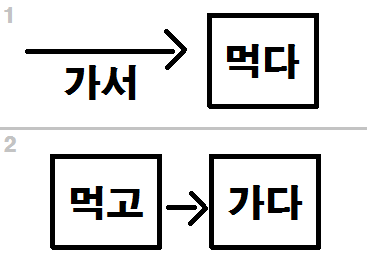
|
||
|
||
When you use 가서 … 먹다, the verb of “going” leads up to the verb of “eating.” However, when you use 먹고 … 가다, even though the verb of “eating” happened before the verb of “going,” they aren’t related to each other.
|
||
|
||
In this same sense, it is possible to attach \~아/어서 to verbs other than 가다 or 오다 to connect two clauses. Below are some examples that show this being done:
|
||
|
||
- 우리는 맛있는 고기를 골라서 같이 먹었어요 <AudioButton src="https://www.howtostudykorean.com/wp-content/uploads/2015/04/Lesson-17-21.mp3" /> = <span class="md spoiler">We chose delicious meat then ate together</span>
|
||
- 문을 열어서 밖으로 나갔어요 <AudioButton src="https://www.howtostudykorean.com/wp-content/uploads/2015/04/Lesson-17-22.mp3" /> = <span class="md spoiler">I opened the door and then went outside</span>
|
||
|
||
While it is very important to know how to use “\~고”, and how to use “\~아/어서” with “가다/오다” at this point, being able to fully understand the nuance of adding “\~아/어서” to other words is beyond your current ability. The usage of \~아/어서 is much more complex, and I will continue to discuss its usage in [Lesson 70](https://www.howtostudykorean.com/unit-3-intermediate-korean-grammar/lessons-67-75/lesson-70/). Also note that the sentence connector \~아/어서 has another meaning that will be discussed in [Lesson 37](https://www.howtostudykorean.com/unit-2-lower-intermediate-korean-grammar/unit-2-lessons-34-41/lesson-37/).
|
||
|
||
It is possible to connect \~고 to “가다” and “오다”, but only in situations where the speaker is connecting sentences that have a similar idea, and not where one goes/comes to a place and does something.
|
||
|
||
For example, I was in my office today and one of my coworkers was telling a current student about all the former students who came to visit him the day earlier (it was Teacher’s Day). He said:
|
||
|
||
- 혜원도 오고… 슬기도 오고… 승하도 오고… 지혜도 오고… <AudioButton src="https://www.howtostudykorean.com/wp-content/uploads/2015/04/Lesson-17-24.mp3" /> = <span class="md spoiler">혜원 came, 슬기 came, 승하 came, 지혜 came, …</span>
|
||
|
||
## Position verbs
|
||
|
||
There are also many position verbs that usually act differently than regular verbs (not just in this situation, but in many situations). The most common of these are to sit (앉다), stand (서다), and to lie down (눕다).
|
||
|
||
The reason these are treated differently is because these are verbs of position. For example, if I just said:
|
||
|
||
- <TTS>저는 먹고 공부했어요</TTS> = <span class="md spoiler">I ate and studied</span>
|
||
|
||
In that sentence, aside from the fact that one action happened after another, 먹다 and 공부하다 have no relation to each other. However, if you were to say:
|
||
|
||
⁠<TTS>저는 눕고 책을 읽었어요</TTS> – That would mean “<span class="md spoiler">I lied down, and then read a book</span>” – as in, I lied down, stood up again, and then read a book. I guess technically you COULD do that, but nobody would ever do that. Instead, what you wanted to say is that you lied down, and then, while lying down, you read a book. In these situations with position verbs, the first action is related to the second action (similar to how 가다 and 오다 are related to the upcoming verb). That is why they are treated differently.
|
||
|
||
If you want to use these position verbs in this way, you need to add \~아/어서 to them:
|
||
|
||
- 저는 누워서 책을 읽었어요 <AudioButton src="https://www.howtostudykorean.com/wp-content/uploads/2017/03/Lesson17-28.mp3" /> = <span class="md spoiler">I lied down and read a book</span>
|
||
- 나는 앉아서 쉴 거야 <AudioButton src="https://www.howtostudykorean.com/wp-content/uploads/2017/03/Lesson17-29.mp3" /> = <span class="md spoiler">I’m going to sit down and relax</span>
|
||
- 저는 줄에 서서 순서를 기다렸어요 <AudioButton src="https://www.howtostudykorean.com/wp-content/uploads/2015/04/Lesson-17-25.mp3" /> = <span class="md spoiler">I stood in line and waited for my turn</span>
|
||
|
||
## I want to: \~고 싶다
|
||
|
||
As I said earlier, \~고 is a verb that can connect two clauses/sentences together. However, there are many other usages of \~고 when also combined with other words. What you are about to learn is SO common (in Korean and English), and I almost want to apologize for waiting until lesson 17 to finally introduce it to you. I just felt that there were other things you needed to learn before this.
|
||
|
||
Anyways, enough apologizing, lets get down to business.
|
||
|
||
Adding \~고 싶다 to the stem of a verb gives it the meaning of “<span class="md spoiler">I want to \_\_\_\_.</span>” Very easy to use:
|
||
|
||
- 저는 한국어를 배우고 싶어요 <AudioButton src="https://www.howtostudykorean.com/wp-content/uploads/2017/03/Lesson17-31.mp3" /> = <span class="md spoiler">I want to study Korean</span>
|
||
- 저는 캐나다에 가고 싶어요 <AudioButton src="https://www.howtostudykorean.com/wp-content/uploads/2017/03/Lesson17-32.mp3" /> = <span class="md spoiler">I want to go to Canada</span>
|
||
- 저는 여자친구를 위해 편지를 쓰고 싶어요 <AudioButton src="https://www.howtostudykorean.com/wp-content/uploads/2017/03/Lesson17-33.mp3" /> = <span class="md spoiler">I want to write a letter for my girlfriend</span>
|
||
- 저는 새로운 차를 사고 싶어요 <AudioButton src="https://www.howtostudykorean.com/wp-content/uploads/2015/04/Lesson-17-26.mp3" /> = <span class="md spoiler">I want to buy a new car</span>
|
||
- 저는 내일 쉬고 싶어요 <AudioButton src="https://www.howtostudykorean.com/wp-content/uploads/2015/04/Lesson-17-27.mp3" /> = <span class="md spoiler">I want to rest tomorrow</span>
|
||
- 저는 저의 친구를 파티에 초대하고 싶어요 <AudioButton src="https://www.howtostudykorean.com/wp-content/uploads/2015/04/Lesson-17-28.mp3" /> = <span class="md spoiler">I want to invite my friend to the party</span>
|
||
- 저는 방학 동안 책 두 권을 읽고 싶어요 <AudioButton src="https://www.howtostudykorean.com/wp-content/uploads/2015/04/Lesson-17-29.mp3" /> = <span class="md spoiler">I want to read two books during vacation</span>
|
||
|
||
It can be used with 되다 to indicate that you want to be/become something:
|
||
|
||
- 저는 선생님이 되고 싶어요 <AudioButton src="https://www.howtostudykorean.com/wp-content/uploads/2017/03/Lesson17-38.mp3" /> = <span class="md spoiler">I want to be/become a teacher</span>
|
||
|
||
It can be used in the past tense as well:
|
||
|
||
- 저는 선생님이 되고 싶었어요 <AudioButton src="https://www.howtostudykorean.com/wp-content/uploads/2017/03/Lesson17-39.mp3" /> = <span class="md spoiler">I wanted to become a teacher</span>
|
||
- 그 여자는 나랑\* 결혼하고 싶었어 <AudioButton src="https://www.howtostudykorean.com/wp-content/uploads/2017/03/Lesson17-40.mp3" /> = <span class="md spoiler">that girl wanted to marry me</span>
|
||
|
||
_Notice that when talking about ‘marrying’ somebody, ‘with’ must be used in Korean instead of attaching_ ‘를/을.’ _Because of this difference in English and Korean, many Korean people will mistakenly say “I want to marry with you.”_
|
||
|
||
Actually, you _have_ come across this \~고 싶다 grammar concept before, but you probably didn’t even realize it. In Korean, there are two ways to say “I miss \_\_\_\_.” One way is to use the word “<TTS>그립다</TTS>” and is used when you “miss” something other than a person (I miss my hometown). The word for missing a person in Korean is 보고 싶다. See anything funny about that word? 보고 – 싶다? Literally, it means “I want to see:”
|
||
|
||
- 저는 친구를 보고 싶어요 <AudioButton src="https://www.howtostudykorean.com/wp-content/uploads/2017/03/Lesson17-41.mp3" /> = <span class="md spoiler">I miss my friend/I want to see my friend</span>
|
||
|
||
\~고 싶다 is not used with adjectives. In English, it is acceptable to say something like “I want to be happy.” If you want to say something like this in Korean, you need to add an additional grammatical principle that changes the meaning to “I want to _become_ happy.” You will learn how to create this meaning with \~아/어지다 in the [next lesson](https://www.howtostudykorean.com/unit1/unit-1-lessons-17-25-2/lesson-18/ "Lesson 18: Present Progressive ~고 있다 (I am ___ing), Adjective + 아/어지다 (Getting ___)").
|
||
|
||
One thing to note is that 싶다 actually acts as an adjective, and must be conjugated as one. This means that:
|
||
|
||
- 나는 먹고 싶다 (<span class="md spoiler">I want to eat</span>) would be a correct conjugation, however
|
||
- ~~나는 먹고 싶는다~~, would be an incorrect conjugation
|
||
|
||
Also, notice the difference between 원하다 and \~고 싶다. You can say 원하다 when you want an object:
|
||
|
||
- 저는 그 책을 원해요 <AudioButton src="https://www.howtostudykorean.com/wp-content/uploads/2017/03/Lesson17-42.mp3" /> = <span class="md spoiler">I want that book</span>
|
||
|
||
and you can use \~고 싶다 when you want to do a verb:
|
||
|
||
- 저는 그 책을 읽고 싶어요 <AudioButton src="https://www.howtostudykorean.com/wp-content/uploads/2017/03/Lesson17-43.mp3" /> = <span class="md spoiler">I want to read that book</span>
|
||
|
||
You can also use “안” or attach “\~지 않다” to 싶다 to indicate that one does not want to do something. For example:
|
||
|
||
- 저는 술을 안 마시고 싶어요 <AudioButton src="https://www.howtostudykorean.com/wp-content/uploads/2015/04/Lesson-17-30.mp3" /> = <span class="md spoiler">I don’t want to drink alcohol</span>
|
||
- 저는 울고 싶지 않아요 <AudioButton src="https://www.howtostudykorean.com/wp-content/uploads/2015/04/Lesson-17-31.mp3" /> = <span class="md spoiler">I don’t want to cry</span>
|
||
- 나는 너를 파티에 초대하고 싶지 않아 <AudioButton src="https://www.howtostudykorean.com/wp-content/uploads/2015/04/Lesson-17-32.mp3" /> = <span class="md spoiler">I don’t want to invite you to the party</span>
|
||
- 저는 부자가 되고 싶지 않아요 <AudioButton src="https://www.howtostudykorean.com/wp-content/uploads/2015/04/Lesson-17-33.mp3" /> = <span class="md spoiler">I don’t want to become a rich man</span>
|
||
- 방학 동안 저는 학교에 있고 싶지 않아요 <AudioButton src="https://www.howtostudykorean.com/wp-content/uploads/2015/04/Lesson-17-34.mp3" /> = <span class="md spoiler">I don’t want to be at school during vacation</span>
|
||
|
||
Sometimes you will learn grammatical principles that are not used so much – but the concepts you learned in this lesson are used _all_ the time. Up until now, actually, it has been hard for me to continue to create good example sentences without the use of \~고 and \~고 싶다.
|
||
|
||
The further and further you go along in these lessons, the more complicated the example sentences will become!
|
||
|
||
Before you move to the next lesson, I would like to continue the discussion from Lesson 2 about \~이/가 and \~는/은.
|
||
|
||
## \~는/은 and \~이/가 Revisited
|
||
|
||
Now it is time to continue what was presented back in [Lesson 2](./02-particles.md). In [Lesson 2](./02-particles.md), you started learning about the differences between \~이/가 and \~는/은.
|
||
|
||
Now that you have increased your understanding of Korean grammar, I can continue to explain the nuances between \~이/가 and \~는/은. At this point, I encourage you to re-read [Lesson 2](./02-particles.md) in order to refresh yourself on what we talked about at that time.
|
||
|
||
One problem with both of these particles is that they both have many functions. Another specific function of \~는/은 (in addition to the <span class="md spoiler">comparison function</span> that you learned in [Lesson 2](./02-particles.md) and the examples I showed you earlier in the lesson) is to indicate <span class="md spoiler">a general fact or statement</span>. For example:
|
||
|
||
- Rocky <TTS>(로키) 산은 높아요</TTS> = <span class="md spoiler">The Rocky Mountains are high (the Rocky Mountain is high)</span>
|
||
|
||
This would be said as a general fact. Everybody would typically know that the Rocky Mountains are high, so this could be said in a general way as seen as above. This can be contrasted with \~이/가. Used this way, \~이/가 wouldn’t be used to describe a general fact about something. Rather, it would be used to describe a specific situation that (usually) the speaker just realized or observed. For example, if you were hiking with your friend, and suddenly got a glimpse of a nearby mountain, you could say:
|
||
|
||
- <TTS>와! 산이 높다!</TTS> = <span class="md spoiler">Wow! The mountain is high!</span>
|
||
|
||
Note here that even though the speaker is talking about this one specific mountain, he or she is not <span class="md spoiler">comparing it with something else</span> (for example, another mountain), as this would require the use of \~는/은 (albeit, in its other usage)
|
||
|
||
Let’s look at more simplified versions of the sentences above:
|
||
|
||
- 산은 높다
|
||
- 산이 높다
|
||
|
||
Remember that the difference between \~이/가 and \~는/은 is more about nuance, and not about creating a different translation in your head. If I attempted to make a translation that describes this nuance for the two examples above, I could maybe write:
|
||
|
||
- 산은 높다 = <span class="md spoiler">In general, mountains are high</span>
|
||
- 산이 높다 = <span class="md spoiler">This mountain that I’m looking at, which I’ve never seen or noticed before, is high</span>
|
||
|
||
At the same time (and this is where people really get confused with these particles) \~는/은 could be used in this situation to have a comparing function. For example, I could say:
|
||
|
||
- 이 산은 높아요. 하지만, 저 산은 낮아요 = <span class="md spoiler">This mountain is tall. But that mountain is low (small)</span>
|
||
|
||
This is precisely what causes the confusion among foreigners when trying to distinguish the difference between \~이/가 and \~는/은. Both of them can be used to express different nuances that seem to overlap each other. For example, if I say:
|
||
“산은 높다”
|
||
|
||
What am I trying to say? Am I trying to say…:
|
||
|
||
- “In general, mountains are high”, or
|
||
- “This mountain, in comparison to that other mountain (or maybe some other thing) is high”
|
||
|
||
The only way you can distinguish between the particular nuances being used is by understanding the situation in which they are said.
|
||
|
||
Let’s look at another example. If I said:
|
||
|
||
- 여름 날씨는 좋다 = <span class="md spoiler">(in general) summer weather is good</span>
|
||
|
||
The purpose of this sentence would be to express a general fact about summer weather. That is, that summer weather is (in general) good. However, if you just walked outside and saw /experienced that the weather is good, you would be more inclined to say:
|
||
|
||
- 날씨가 좋다 = <span class="md spoiler">The weather (right now that I am experiencing) is good</span>
|
||
|
||
Here, the speaker is just indicating that the weather at the moment is good, and is not talking about the weather being good all the time.
|
||
This doesn’t mean that “날씨는 좋다” is incorrect. You most definitely could use that sentence, but only in an appropriate situation. This was the dialogue I had with a Korean person:
|
||
|
||
- Me: When would you be able to say “날씨는 좋다”. It clearly isn’t used as a general statement, because weather (in general) isn’t always good. So when could I say this?
|
||
- Korean person: It sounds like you are comparing it with something. Like, you are saying that the weather is good, but something else might be bad.
|
||
- Me: For example?
|
||
- Korean person: Maybe, “여기 음식이 맛이 없어요. 하지만 날씨는 좋아요.” (<span class="md spoiler">The food here isn’t delicious, but the weather is good</span>). Here, you’re saying that the weather is good, but the food is bad.
|
||
|
||
That’s the thing about \~이/가 and \~는/은. It’s not about understanding their meanings. Their meanings can’t be translated into English. It’s about understanding the nuances they possess when used in different situations.
|
||
|
||
Let’s look at another example:
|
||
|
||
- <TTS>다이아몬드는 딱딱하다</TTS> = <span class="md spoiler">(in general) Diamonds are hard</span>
|
||
|
||
(This is a statement that can be applied generally. Most people would know that diamonds are hard, and this is not new information or anything like that)
|
||
|
||
However, if somebody picked up a diamond and felt it, and realizes exactly how hard that particular diamond is, they would be more inclined to say:
|
||
|
||
- 다이아몬드가 너무 딱딱하다 = <span class="md spoiler">Diamonds are hard (due to the experience that I have right now with this diamond, I can see/realize that this diamond is very hard!)</span>
|
||
|
||
_(Please try to ignore my attempt to translate this nuance. It would never actually be translated to that.)_
|
||
|
||
Now, if we changed the noun:
|
||
|
||
- 밥은 딱딱하다 = <span class="md spoiler">The rice is hard</span>
|
||
|
||
This would not be expressed as a general statement. Why? Because rice is generally not hard. However, if you were about to have dinner with the rice on your plate and you touched it, you could say:
|
||
|
||
- 밥이 딱딱하다 = <span class="md spoiler">The rice is hard (due to what I am experiencing right now, I can say that this particular rice is hard)</span>
|
||
|
||
_(Again, please ignore this ridiculous translation)_
|
||
|
||
Now this:
|
||
|
||
- 밥은 딱딱하다 = <span class="md spoiler">The rice is hard</span>
|
||
|
||
Again, this is not a general statement. Therefore… is it wrong?
|
||
|
||
No, because there are other purposes of \~는/은. Maybe here the speaker wanted express the comparison function of \~는/은. Maybe to say that the soup is hot (and ready to eat), but the rice is hard. Remember, all of this is situational.
|
||
|
||
Another example:
|
||
|
||
(<TTS>빨갛다</TTS> = <span class="md spoiler">red</span>, <TTS>노랗다</TTS> = <span class="md spoiler">yellow</span>. These words aren’t introduced until Lesson 23. Sorry.)
|
||
|
||
- <TTS>사과는 빨갛다</TTS> = <span class="md spoiler">(in general) apples are red</span>, or
|
||
- <TTS>사과는 빨갛다. 바나나는 노랗다</TTS> = <span class="md spoiler">Apples are red. Bananas are yellow</span>
|
||
- <TTS>사과가 빨갛다</TTS> = <span class="md spoiler">the apple is red (the apple that I am looking at that I just noticed)</span>
|
||
- <TTS>사과가 파랗다</TTS> = <span class="md spoiler">the apple is blue</span>
|
||
|
||
(this would not normally be the case and therefore would never be used with \~는/은 to express a general statement meaning. However, \~이/가 is used here to specifically describe the apple that the speaker is experiencing – which may or may not follow what is typical of other apples)
|
||
|
||
- 의사들은 똑똑하다 = <span class="md spoiler">(in general), doctors are smart</span>
|
||
- 그 의사가 아주 똑똑하다 = <span class="md spoiler">the doctor is smart (the one specific doctor who is in the room, for example)</span>
|
||
|
||
This is why, when you want to say “it is raining” you must use the following sentence:
|
||
|
||
- <TTS>비가 와요</TTS> = <span class="md spoiler">It’s raining</span>
|
||
|
||
Instead of:
|
||
|
||
- ~~비는 와요…~~ (incorrect)
|
||
|
||
The use of “비는 와요” would suggest that, in general, it rains; which wouldn’t make sense. Instead, the fact that it is raining/rained/will rain would always fall into the particular situation that “이/가” is used for.
|
||
|
||
I said this at the end of [Lesson 2](./02-particles.md), but I’m going to say it again here. Your understanding of exactly when to use \~는/은 over \~이/가 and vice-versa will progress with your general understanding of Korean grammar.
|
||
|
||
Also remember that sentences (in every language, including Korean) are usually much more complicated than what is presented in this lesson. In addition, very rarely are sentences said as just ‘one-off’ sentences. Rather, they are said in response to a question or statement, which is important information in understanding the nuances of both \~이/가 and \~는/은.
|
||
|
||
I am sorry to do this again, but you _still_ haven’t learned everything you need to know about \~이/가. Once again, I need to send you along without having learned everything.
|
||
|
||
In order to understand the next explanation detailing the usages of \~이/가 and \~는/은, you need to have some understanding of how questioning works in Korean. I will continue this explanation at the end of [Lesson 22](https://www.howtostudykorean.com/unit1/unit-1-lessons-17-25-2/lesson-22/ "Lesson 22: Asking Questions in Korean: How, What, Which, How Many").
|
||
|
||
For now, continue on to [Lesson 18](https://www.howtostudykorean.com/?page_id=1261).
|
||
[Click here for a workbook to go along with this lesson.](https://www.howtostudykorean.com/workbooks/#Unit1725 "Workbooks")
|
||
|
||
## Summary
|
||
|
||
<YouTube id=xWchKlJuZF0 />
|
||
|
||
Want to try to create some sentences using the vocabulary and grammar from this lesson?
|
||
|
||
This YouTube video will prompt you to translate English sentences into Korean using the concepts from this lesson.
|
||
|
||
<YouTube id=h1aB4Ht-H24 />
|
||
|
||
Want to practice your listening skills?
|
||
|
||
This YouTube video will prompt you with Korean sentences to dictate using the concepts from this lesson.
|