
108 KiB
vocabulary, sentence
| vocabulary | sentence | ||||||||||||||||||||||||||||||||||||||||||||||||||||||||||||||||||||||||||||||||||||||||||||||||||||||||||||||||||||||||||||||||||||||||||||||||||||||||||||||||||||||||||||||||||||||||||||||||||||||||||||||||||||||||||||||||||||||||||||||||||||||||||||||||||||||||||||||||||||||||||||||||||||||||||||||||||||||||||||||||||||||||||||||||||||||||||||||||||||||||||||||||||||||||||||||||||||||||||||||||||||||||||||||||||||||||||||||||||||||||||||||||||||||||||||||||||||||||||||||||||||||||||||||||||||||||||||||||||||||||||||||||||||||||||||||||||||||||||||||||||||||||||||||||||||||||||||||||||||||||||||||||||||||||||||||||||||||||||||||||||||||||||||||||||||||||||||||||||||||||||||||||||||||||||||||||||||||||||||||||||||||||||||||||||||||||||||||||||||||||||||||||||||||||||||||||||||||||||||||||||||||||||||||||||||||||||||||||||||||||||||||||||||||||||||||||||||||||||||||||||||||||||||||||||||||||||||||||||||||||||||||||||||||||||||||||||||||||||||||||||||||||||||||||||||||||||||||||||||||
|---|---|---|---|---|---|---|---|---|---|---|---|---|---|---|---|---|---|---|---|---|---|---|---|---|---|---|---|---|---|---|---|---|---|---|---|---|---|---|---|---|---|---|---|---|---|---|---|---|---|---|---|---|---|---|---|---|---|---|---|---|---|---|---|---|---|---|---|---|---|---|---|---|---|---|---|---|---|---|---|---|---|---|---|---|---|---|---|---|---|---|---|---|---|---|---|---|---|---|---|---|---|---|---|---|---|---|---|---|---|---|---|---|---|---|---|---|---|---|---|---|---|---|---|---|---|---|---|---|---|---|---|---|---|---|---|---|---|---|---|---|---|---|---|---|---|---|---|---|---|---|---|---|---|---|---|---|---|---|---|---|---|---|---|---|---|---|---|---|---|---|---|---|---|---|---|---|---|---|---|---|---|---|---|---|---|---|---|---|---|---|---|---|---|---|---|---|---|---|---|---|---|---|---|---|---|---|---|---|---|---|---|---|---|---|---|---|---|---|---|---|---|---|---|---|---|---|---|---|---|---|---|---|---|---|---|---|---|---|---|---|---|---|---|---|---|---|---|---|---|---|---|---|---|---|---|---|---|---|---|---|---|---|---|---|---|---|---|---|---|---|---|---|---|---|---|---|---|---|---|---|---|---|---|---|---|---|---|---|---|---|---|---|---|---|---|---|---|---|---|---|---|---|---|---|---|---|---|---|---|---|---|---|---|---|---|---|---|---|---|---|---|---|---|---|---|---|---|---|---|---|---|---|---|---|---|---|---|---|---|---|---|---|---|---|---|---|---|---|---|---|---|---|---|---|---|---|---|---|---|---|---|---|---|---|---|---|---|---|---|---|---|---|---|---|---|---|---|---|---|---|---|---|---|---|---|---|---|---|---|---|---|---|---|---|---|---|---|---|---|---|---|---|---|---|---|---|---|---|---|---|---|---|---|---|---|---|---|---|---|---|---|---|---|---|---|---|---|---|---|---|---|---|---|---|---|---|---|---|---|---|---|---|---|---|---|---|---|---|---|---|---|---|---|---|---|---|---|---|---|---|---|---|---|---|---|---|---|---|---|---|---|---|---|---|---|---|---|---|---|---|---|---|---|---|---|---|---|---|---|---|---|---|---|---|---|---|---|---|---|---|---|---|---|---|---|---|---|---|---|---|---|---|---|---|---|---|---|---|---|---|---|---|---|---|---|---|---|---|---|---|---|---|---|---|---|---|---|---|---|---|---|---|---|---|---|---|---|---|---|---|---|---|---|---|---|---|---|---|---|---|---|---|---|---|---|---|---|---|---|---|---|---|---|---|---|---|---|---|---|---|---|---|---|---|---|---|---|---|---|---|---|---|---|---|---|---|---|---|---|---|---|---|---|---|---|---|---|---|---|---|---|---|---|---|---|---|---|---|---|---|---|---|---|---|---|---|---|---|---|---|---|---|---|---|---|---|---|---|---|---|---|---|---|---|---|---|---|---|---|---|---|---|---|---|---|---|---|---|---|---|---|---|---|---|---|---|---|---|---|---|---|---|---|---|---|---|---|---|---|---|---|---|---|---|---|---|---|---|---|---|---|---|---|---|---|---|---|---|---|---|---|---|---|---|---|---|---|---|---|---|---|---|---|---|---|---|---|---|---|---|---|---|---|---|---|---|---|---|---|---|---|---|---|---|---|---|---|---|---|---|---|---|---|---|---|---|---|---|---|---|---|---|---|---|---|---|---|---|---|---|---|---|---|---|---|---|---|---|---|---|---|---|---|---|---|---|---|---|---|---|---|---|---|---|---|---|---|---|---|---|---|---|---|---|---|---|---|---|---|---|---|---|---|---|---|---|---|---|---|---|---|---|---|---|---|---|---|---|---|---|---|---|---|---|---|---|---|---|---|---|---|---|---|---|---|---|---|---|---|---|---|---|---|---|---|---|---|---|---|---|---|---|---|---|---|---|---|---|---|---|---|---|---|---|---|---|---|---|---|---|---|---|---|---|---|---|---|---|---|---|---|---|---|---|---|---|---|---|---|---|---|---|---|---|---|---|---|---|---|---|---|---|---|---|---|---|---|---|---|---|---|---|---|---|---|---|---|---|---|---|---|---|---|---|---|---|---|---|---|---|---|---|---|---|---|---|---|---|---|---|---|---|---|---|---|---|---|---|---|---|---|---|---|---|---|---|---|---|---|---|---|---|---|---|---|---|---|---|---|---|---|---|---|---|---|---|---|---|---|---|---|---|---|---|---|---|---|---|---|---|---|---|---|---|---|---|---|---|---|
|
|
Lesson 11: 동안, Seconds, Minutes, Hours, Days, Weeks, Months, Years
Vocabulary
Months of the year
1월 (일월) = January
2월 (이월) = February
3월 (삼월) = March
4월 (사월) = April
5월 (오월) = May
6월 (유월*) = June
7월 (칠월) = July
8월 (팔월) = August
9월 (구월) = September
10월 (시월*) = October
11월 (십일월) = November
12월 (십이월) = December
*June (6월/유월) and October (10월/시월) should actually be 육월 and 십월 but, written like that, they are difficult to pronounce. Because of this, their correct pronunciations are 유월 and 시월 NOT 육월 and 십월.
Nouns
기회 = chance/opportunity
Common Usages:
- 기회를 놓치다 = to miss an opportunity
- 기회를 잡다 = to seize an opportunity
- 기회를 기다리다 = to wait for an opportunity
- 기회를 얻다 = to gain/get an opportunity
- 기회를 노리다 = to aim for an opportunity
Examples:
- 이것은 저의 마지막 기회예요 = This is my last chance
- 저는 의견을 말할 기회가 아직 없어요 = I still haven’t had a chance to say my opinion
- 그는 직업을 바꿀 수 있는 기회를 잡았어요 = He seized the opportunity to change jobs
계획 = plans
Common Usages:
- ~ㄹ/을 계획이 있다 = to have plans to do (Introduced in Lesson 50)
Example:
- 저는 내일 계획이 있어요 = I have plans tomorrow
- 서울에 갈 계획이 있어요 = I have plans to go to Seoul
- 제가 친구를 만날 계획이 있었지만 친구는 안 왔어요 = I had plans to meet my friend, but he didn’t come
- 우리가 지난 번에 계획이 없었어요 = We didn’t have plans last time
- 저는 5일 동안 계획이 없을 거예요 = I won’t have plans for 5 days
- 저는 그 날에 계획이 있어요 = I have plans on that day
- 원래 대학교에 갈 계획이 있었지만 수능을 잘 못 봐서 대학교에 갈 수 없었어요 = I had plans to go to university, but I couldn’t get in because I did poorly on the SAT test
회사원 = office worker
Notes:
If I asked 100 people in Canada what their job is, I would probably only get the answer “office worker” a few times. In Korea however, probably 50% of the people would respond with “office worker.” Many Korean people work for big companies in offices, not all doing the same thing obviously, but I’m not exactly sure what they’re all doing in there. Korea has no real natural resources, so the major industry is just “working and business.”
You will see the suffix “원” attached to different words to refer to people.
Example:
- 한국에서는 회사원이 진짜 많아요 = There are a lot of office workers in Korea
- 우리 회사는 새로운 회사원을 찾고 있어요 = Our company is looking for new workers
요리사 = a cook/chef
Notes:
You will see the suffix “사” attached to different words that indicate some sort of specialized job. For example: 의사 (doctor), 교사 (teacher), 강사 (instructor)
Example:
- 요리사들은 음식을 준비해요 = Chefs prepare food
- 요리사들은 저녁을 부엌에서 준비했어요 = The chefs prepared the dinner in the kitchen
운전사 = a driver
Common Usages:
- 택시 운전사 = taxi driver
- 버스 운전사 = bus driver
- 트럭 운전사 = truck driver
Notes:
This is not the same “사” in 요리사.
“기사님” is common when talking to bus and taxi drivers
Example:
- 버스운전사는 승객들을 버스에 서울역에서 태웠어요 = The bus driver took on riders at Seoul Station
Verbs
달리다 = to run
Common Usages:
- 달리기 = running
Notes:
“뛰다” is another common way to say “to run”
Example:
- 저는 매우 빨리 달렸어요 = I ran really quickly
- 저는 1시간 동안 달렸어요 = I ran for one hour
- 저는 집 안에서 달렸어요 = I ran inside the house
- 저는 달리기를 제일 빨리 할 수 있어요 = I can run the fastest (the most fast)
- 그 학생은 모든 학생들보다 더 빨리 달려요 = That student runs faster than any other student
- 그는 축구선수인 만큼 달리기를 잘해요 = He runs as well as a soccer athlete/player
요리하다 = to cook
The noun form of this word translates to “cooking”
Common Usages:
- 요리사 = chef
Example:
- 우리 엄마는 요리를 잘 해요 = Our mom is good at cooking
- 엄마가 요리한 음식은 너무 맛있어요 = The food my mom cooked is delicious
- 저의 아내는 자기가 요리한 것을 보통 안 먹어요 = My wife usually doesn’t eat the food she cooks
- 저의 할머니는 요리를 너무 잘해요 = My grandmother cooks very well
운전하다 = to drive
Common Usages:
- 운전사 = driver
- 음주 운전 = drunk driving
- 운전면허 = driver’s license
- 국제운전면허 = International driver’s license
- 운전을 못하다 = to be bad at driving
Example:
- 트럭을 운전할 수 있어요? = Can you drive a truck?
- 저는 8시간 동안 운전했어요 = I drove for eight hours
- 저는 차를 안전히/안전하게 운전했어요 = I drove the car safely
- 우리 아버지는 차를 항상 안전하게 운전해요 = Our dad always drives his car safely
- 그 고속도로에서 트럭을 운전해서는 안 돼요 = You must not drive a truck on that highway
죽다 = to die
The pronunciation of this word is closer to “죽따”
Common Usages:
- 죽음 = death
- 힘들어 죽겠다 = a common saying where people say “ah, it’s so difficult, I’m going to die”
- 배불러 죽겠다 = a common saying where people say "ah, I’m so full, I’m going to die"
Examples:
- 그 사람은 10년 전에 죽었어요 = That person died 10 years ago
- 그 사람은 작년에 죽었어요 = That person died last year
- 그곳에 있었던 사람들은 다 죽었다 = All the people that were there died
- 그녀는 아이가 죽었다는 사실을 숨겼어요 = She hid (the fact that) her child died
Adjectives
두렵다 = to be scared
The pronunciation of this word is closer to “두렵따”
두렵다 follows the ㅂ irregular
Notes:
무섭다 and 두렵다 both translate to “scary.” 무섭다 is more typically used to describe the feeling of being scared, usually as it applies to something shocking or something outright scary like snakes or spiders. 두렵다 is more about psychological things in the future, like the fear of death or the fear of tomorrow.
두렵다 and 무섭다 typically describe that something is scary, but it can be used to indicate that you are scared of that thing by using the Subject – Object – Adjective form introduced in Lesson 15.
Example:
- 그녀를 잃는 것이 두려워요 = I am afraid of losing her
- 저는 모르는 것이 두려워요 = I am afraid of things that I don’t know (the unknown)
- 저는 죽는 것이 두려워요 = I am afraid of dying
이상하다 = to be strange
The noun form of this word translates to “abnormality”
Common Usages:
- 이상해 보이다 = to look strange
- 이상한 것이 없다 = to be nothing unusual
- 이상한 느낌 = a strange feeling
Example:
- 그 건물은 이상해 보여요 = That building looks strange
- 그는 이상한 남자예요 = He is a strange man
- 맛이 조금 이상해요 = The taste is a little bit strange
- 저는 어젯밤 이상한 꿈을 꾸었어요 = I had a weird dream last night
Adverbs and Other words
동안 = for, during, while
Notes:
Used to indicate how long something is being done. Often placed after an indication of time.
For example:
- 10분 동안 = 10 minutes
In this same sense, it can be placed after a noun that describes a time. For example:
- 방학 동안 = during vacation
- 수업 시간 동안 = during class time
Also used with ~는 것 (Introduced in Lesson 26) to say “while.” For example:
- 제가 공부하는 동안 = while I was studying
Example:
- 저는 30분 동안 공부했어요 = I studied for 30 minutes
- 저는 공부하는 동안 밥을 먹었어요 = I ate while studying
- 저는 방학 동안 공부를 많이 했어요 = I studied a lot during vacation
- 반지를 사려고 두 달 동안 돈을 안 썼어요 = In order to buy a ring, I didn’t spend money for two months
- 저는 삼일 동안 밥을 안 먹었어요 = I didn’t eat rice for 3 days
- 텔레비전을 오랫동안 보지 마세요! = Don’t watch TV for a long time!
- 저는 두 달 동안 한국어 수업을 들었어요 = I took a Korean class for 2 months
- 저는 10분 동안 걸었어요 = I walked for 10 minutes
- 저는 1년 동안 영어를 외국에서 공부했어요 = I studied English in a foreign country for 1 year
- 저는 6개월 동안 여행했어요 = I travelled for 6 months
달 = month
Common Usages:
- 두 달 동안 = for two months
- 세 달 동안 = for three months
- 달력 = calendar
Notes:
When counting months, you can either use 달 or 개월. When using 달, you must use the pure Korean numbers, and when using 개월, you must use the Sino-Korean numbers. There is no difference in meaning, and both are used frequently
Example:
- 저는 두 달 동안 한국어 수업을 들었어요 = I took a Korean class for 2 months
- 저는 여기에 한 달에 세 번 와요 = I come here three times per month
- 다음 달에 한국어를 배우기 시작할 거예요 = I will start learning Korean next month
개월 = month
Notes:
When counting months, you can either use 달 or 개월. When using 달, you must use the pure Korean numbers, and when using 개월, you must use the Sino-Korean numbers. There is no difference in meaning, and both are used frequently
Example:
- 저는 2개월 동안 한국어 수업을 들었어요 = I took a Korean class for 2 months
- 저는 6개월 동안 여행했어요 = I traveled for 6 months
- 우리는 사귄 지 3개월 되었어요 = We have been going out for 3 months
날 = day
Notes:
날 is used as a stand alone word and not counted. It is used when talking about a specific day by itself.
Examples:
- 저는 그 날에 갔어요 = I went on that day
- 저는 그 날에 계획이 있어요 = I have plans on that day
- 저는 그 날에 선생님이 되었어요 = I became a teacher on that day
- 우리는 그 날에 시작할 거예요 = We will start on that day
하루 = one day
Common Usages
- 하루 종일 = all day
- 하루 동안 = for one day
- 하루에 세 번 = three times per day
- 하루에 한 번 = once per day
- 하룻밤 = one night
Notes:
When counting the number of days, you can usually say something like “5일” (five days). However, for a small number of days (one day, two days) there is a special word that corresponds to that number of days. “일 일” to mean “one day” would never be used.
Example:
- 저는 하루에 3시간 동안 공부해요 = I study for three hours in one day
- 저는 하루 동안 여행했어요 = I traveled for one day
- 저는 하루에 4시간 동안 공부해요 = I study for four hours per day
- 그 학생은 하루 종일 책을 읽을 수 있어요 = That student can read books all day
- 저는 이 약을 하루에 두 번 먹어요 = I eat (take) this medicine twice per day
- 저의 게으른 남동생은 하루 종일 아무것도 안 해요 = My lazy brother doesn’t do anything all day
- 그는 하루 종일 그냥 컴퓨터를 해요 = He just uses the computer all day
- 모든 학생들은 하루 종일 잤어 = All students slept all day
이틀 = two days
Common Usages
- 이틀 동안 = for two days
- 이틀에 한 번 = once per two days
Notes:
When counting the number of days, you can usually say something like “5일” (five days). However, for a small number of days (one day, two days) there is a special word that corresponds to that number of days. “이 일” to mean “two days” would be used, but 이틀 would be more common.
Example:
- 우리는 계곡에 이틀 동안 갈 거예요 = We are going to the valley for two days
- 저는 이틀 동안 안 잤어요 = I didn’t sleep for two days
- 우리는 이틀 동안 미국에 있었어요 = We were in America for two days
- 우리는 이틀 전에 한국에 왔어요 = We came to Korea two days ago
- 저는 그 친구를 이틀 후에 만날 거예요 = I will meet that friend two days from now
사흘 = three days
Notes:
Even though “사” (‘four’) is in the word “사흘,” I assure you that 사흘 means “3 days.” Many Korean people think that “사흘” actually means “four days,” and I have pwned some Korean people by showing them that it actually means “three days” by looking it up in the Korean-Korean dictionary with them.
Example:
- 저는 사흘 동안 밥을 안 먹었어요 = I didn’t eat rice for 3 days
지난 주 = last week
Notes:
지난 can be placed before some indicators of time to mean “last ….”
There are two similar but different meanings for the word “last” in English. 지난 is used for only ONE of those meanings. 지난 is used to talk about something in the past, as in “last night I went to bed late.” It is not used to talk about the last thing in a sequence. See Lessons 10 and 11 for more information.
Example:
- 지난 주에 저는 계획이 많았어요 = I had a lot of plans last week
- 그는 그녀를 지난 주에 해고했을 것 같아요 = It appears that he fired her last week
- 저의 여동생은 지난 주에 책 두 권을 읽었어요 = My sister read two books last week
- 지난 주말에 뭐 했어요? = What did you do last weekend?
- 저는 그 영화를 지난 주에 봤어요 = I saw that movie last week
- 지난 주에 우리는 아무데도 안 갔어요 = We didn’t go anywhere last week
- 저는 지난 주에 영화를 봤어요 = I saw a movie last week
지난 달 = last month
Example:
- 저는 지난 달에 그 시험을 봤어요 = I took that exam last month
- 학생은 지난 달보다 더 많이 공부하고 있어요 = The student is studying more than last month
이번 주 = this week
Example:
- 우리가 이번 주에 뭐 할 거예요? = What are we going to do this week?
- 저는 이번 주에 계획이 없어요 = I have no plans this week
이번 달 = this month
Example:
- 그녀는 이 번 달에 애기를 낳을 예정이에요 = She is scheduled to give birth this month
- 저는 친구를 이번 달에 만날 거예요 = I will meet (that/a) friend this month
다음 주 = next week
Notes:
다음 can be placed before some indicators of time to mean “next”
Example:
- 학생들은 다음 주에 학교에 돌아와요 = The students return to school next week
- 저는 다음 주에 영화를 볼 거예요 = I will see a movie next week
- 저는 다음 주에 캐나다에 갈 거예요 = I will go to Canada next week
- 저는 다음 주에 미국에 갈 거예요 = I will go to the US next week
- 저는 다음 주에 시험 공부를 할 거예요 = Next week, I will study for an exam
- 다음 주 목요일은 휴가인가? = Is next Thursday a holiday?
- 아직 간 적이 없어요. 하지만 다음 주에 가 볼 거예요 = I haven’t been there yet. But, I am going (to try) to go next week
- 우리는 다음 주에 그 문제에 대한 회의를 열 거예요 = We are going to hold a meeting next week about that problem
다음 달 = next month
Example:
- 다음 달은 지금보다 더 춥겠어요 = Next month will be colder than now
- 다음 달에 한국어를 배우기 시작할 거야 = I will start learning Korean next month
작년 = last year
Example:
- 작년에 어디서 공부했어요? = Where did you study last year?
- 저는 작년에 살이 많이 쪘어요 = I gained a lot of weight last year
- 그는 작년보다 한국어를 훨씬 잘해요 = He is much better at Korean than last year
- 작년에 우리 회사의 수입은 200만원이었어요 = Our company’s income last year was 200만
- 제가 작년에 가르친 학생 한 명은 벌써 의사가 되었어요 = One of the students I taught last year has already become a doctor
올해 = this year
Example:
- 우리는 올해 결혼하고 싶어요 = We want to get married this year
- 저의 어머니는 올해 한국에 올 것입니다 = My mom will come to Korea this year
내년 = next year
Example:
- 우리는 내년에 결혼하고 싶어요 = We want to get married next year
- 저는 내년에 한국에 갈 거예요 = I will go to Korea next year
평생 (동안) = in my whole life
This word appears in Korean Sign Explanation [Video 12]
Common Usages:
- 평생 동안 = throughout my whole life
- 평생 동반자 = lifelong companion
Examples:
- 저는 평생 동안 하키를 했어요 = I played hockey my whole life
- 저는 평생 동안 오렌지를 세 번밖에 안 먹어 봤어요
- I have only eaten oranges three times in my life
- 저는 평생 동안 담배를 한 모금도 안 피웠어요
- In my whole life, I haven’t even had one puff/drag of a cigarette
- 그 사람이 부잣집에 태어나서 평생 동안 돈을 쓰는 것에 대해 한번도 걱정 안 했어요
- That person was born into a rich family, so during his whole life he never had to worry about spending money
보통 = usually
Notes:
This can be used as an adverb, for example:
- 저는 보통 아침 식사를 안 먹어요 = I usually don’t eat breakfast
- 피자를 먹으면 저는 콜라를 보통 마셔요 = When/If I eat pizza, I usually drink cola
- 배우들은 그들의 영화를 보통 좋아하지 않아 = Actors usually don’t like their movies
- 저는 보통 점심식사로 과일만 먹어요 = I usually only eat fruit for lunch
- 한국 사람들은 보통 아주 착해요 = Korean people are usually very nice
It can also be used before a noun to mean “typical” or “usual” for example:
- 그것은 보통 일이에요 = That is (just) typical work
You might also want to try listening to all of the words on loop with this [Vocabulary Practice video]
There are 1050 vocabulary entries in Unit 1. All entries are linked to an audio file. You can download all of these files in one package here.
Introduction
In this lesson, you will build on what you learned in Lesson 10 by learning how to use a variety of different words of time in Korean. Using these words, you will be able to say “I did X for 2 months” or “I didn’t do Y last week.” You will also learn whether you should use the pure Korean or Sino-Korean numbers when using these different words of time.
The use of pure Korean or Sino-Korean numbers may seem random, but there is a reason for it. Anytime the ‘time’ word is of Chinese origin, the Sino-Korean numbers are used. For example “개월” (month) is counted using Sino-Korean numbers, because “개월” is of Chinese origin and has corresponding Chinese (한자) characters. “달” (also meaning month) is a Korean word, and thus, is counted using Korean numbers. A lot of Korean words are of Chinese origin and have corresponding Chinese (한자) characters. You will learn about those later.
This lesson is a little bit less organized than the previous lessons. It was difficult to teach everything in this lesson together because you need to have a mutual understanding of all concepts in order to understand one of them. In order to understand how to use 동안, you need to know how to use 주. But in order to understand how to use 주, you should understand how to use 동안. Around and around we go. Anyways, I made it as simple as possible. After this lesson, any time you learn about other ‘time’ grammar concepts, it should be really easy because this lesson will give you a solid base to work from.
“For” a certain amount of time (동안)
동안 is a very useful word that can be used to indicate how long an action occurs. It is typically placed after a duration of time, for example:
- 2분 = 2 minutes
- 2분 동안 = for 2 minutes
- 10분 = 10 minutes
- 10분 동안 = for 10 minutes
- 이틀 = two days
- 이틀 동안 = for two days
동안 can also be used to indicate that an action occurs “while” another action occurs. You will learn about that application in Lesson 33 after learning some key grammar points in the lessons to come.
Those can then be added into sentences to indicate how long one does something for. Notice also that no additional particle is added to 동안. One would think that 에 should be added, but it is not.
- 저는 10분 동안 걸었어요 = I walked for 10 minutes
- 저는 30분 동안 공부했어요 = I studied for 30 minutes
While the translation of “동안” in these examples is usually “for”, in essence, what you are doing is stating “for that period of time.” Understanding this will help you understand later usages of “동안” in future lessons. For example:
- 저는 10분 동안 걸었어요 = I walked for (a period of) 10 minutes
- 저는 30분 동안 공부했어요 = I studied for (a period of) 30 minutes
- 저는 이틀 동안 안 잤어요 = I didn’t sleep for two days
Remember:
It doesn’t matter if you use the word or the numeral when writing a number. However, typically the word is written when a pure Korean word is used with a counter like 개, 명, 번, 시간, 대, 살, etc. In situations where Sino-Korean numbers are written (for example, in the sentences above) it makes no difference if you write the numeral or the word.
Also remember that the spacing is different depending on if you write a numeral or a word. If writing the word, there should be a space between the number and the word. For example:
- 저는 십 분 동안 걸었어요
If writing a numeral, it doesn’t matter if you include a space or not. Both are seen as acceptable:
- 저는 10분 동안 걸었어요
- 저는 10 분 동안 걸었어요
I want to show you more and more examples of 동안, and I expect you might not want to limit yourself to only “분” (minutes), so lets move on to hours.
Korean Hours (시간)
Talking about minutes is easy because you always simply use 분. For example:
- 3시 20분 means “3:20”, and
- 20분 동안 means “for 20 minutes”
When talking about hours, however, 시 is used when talking about the hour on a clock, whereas 시간 is used when counting hours. Notice the difference between these two sets:
- 3시 = 3:00
- 세 시 = Three o’clock
- 3시간 동안 = for 3 hours
- 세 시간 동안 = for three hours
Remember that pure Korean numbers are used when talking about hours. I usually write out the Korean word when I’m referring to an amount of hours as in the examples below. For example:
- 저는 세 시간 동안 잤어요 = I slept for 3 hours
- 저는 한 시간 동안 달렸어요 = I ran for one hour
- 저는 여덟 시간 동안 운전했어요 = I drove for eight hours
- 저는 어제 한 시간 동안 야구를 했어요 = I played baseball for an hour yesterday
- 저는 어제 두 시간 동안 TV를 봤어요* = I watched TV for two hours yesterday
*Notice that 보다 (to see) is used when watching something. You can also use 보다 when you watch a performance or concert, or similar things. In English “I saw a TV” and “I watched TV” have two different meanings, but Koreans simply say “I see TV.”
At this point you are probably asking saying “Okay, I understand how to say that I have done things for X hours or minutes, but what about if I want to say something like:
- I will eat in three hours, or
- I ate three hours ago
- I will go in 10 minutes, or
- I came 10 minutes ago”
You will learn how to create those types of sentences when you learn about 전 and 후 in Lesson 24. For the moment, there is a ton of content in this lesson, so try to focus on what is presented here.
Korean Seconds (초)
When talking about seconds, you need to use the Sino-Korean numbers. When putting a number before “초,” it doesn’t matter if you use the word or the numeral. For example:
- 1초 = 1 second
- 일 초 = one second
- 2초 = 2 seconds
- 이 초 = two seconds
- 2초 동안 = for 2 seconds
- 이 초 동안 = for two seconds
Examples in sentences:
- 저는 2초 동안 달렸어요 = I ran for 2 seconds
- 저는 그 사람을 10초 동안 만났어요 = I met that person for 10 seconds
- 1분은 60초입니다 = One minute is sixty seconds
Last/Next (지난/다음)
지난 and 다음 are two words that you can use in many situations, including in situations related to time. In Lesson 10, you learned about 마지막, which can be used to refer to the “last” or “final” thing in a sequence. Remember, Korean people use another word when referring to a “previous” (or last) thing, as in: “I saw a movie last (the previous) week.”
In order to refer to a “previous” thing, the word “지난” can be used. I drew a picture to depict the image I have in my head distinguishing 마지막 and 지난. Imagine you are on a six week trip, and you are currently in your fourth week of the trip. You can use “지난” to refer to the previous week, and you can use “마지막” to refer to the final week. (You can refer to them both as “last week” in English). For example:
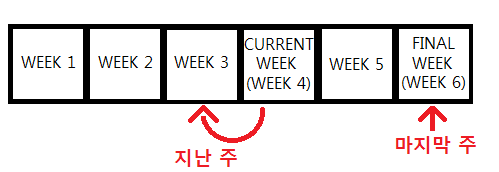
지난 can be added immediately before some words of time (I discuss “some” a little bit later) to refer to a “previous” thing. This often translates to “last,” though. For example:
- 저는 지난 주에 영화를 봤어요 = I saw a movie last week
- 저는 지난 주에 캐나다에 갔어요 = I went to Canada last week.
- 저는 지난 수업을 안 들었어요 = I didn’t go to/attend the last/previous class
In order to say “attend a class,” Korean people say “수업을 듣다,” which literally translates to “listen to/hear a class.” As such, you can see that the particle *을 *is attached to “수업” because “the class” is the noun that is being listened to. Korean learners are sometimes confused as to why “에” is not attached to “수업” because they are accustomed to the English way of saying “I didn’t go to the last class”.*
Also, note that this sentence is also correct, but is referring to a different class than above:
- 저는 마지막 수업을 안 들었어요 = I didn’t attend the last class
지난 can be added only before some words of time. For example, you couldn’t say “지난 분/지난 초.” These would mean “last minute/second” as in ‘the last minute/second’ that just passed – which doesn’t make any sense. Notice that they do not have the meaning of “I handed in my paper at the last minute.” This meaning refers to the last minute in a sequence of minutes; therefore, “마지막” must be used in this case.
시간, however, means “time” in addition to being a counter for “hours.” So, “지난 시간” can be used to mean “last time” (but not “last hour”).
- 저는 그것을 지난 시간에 배웠어요 = I learned that (thing) last time
You can also use the word 번 to refer to the last “time” something happened.
- 저는 그것을 지난 번에 배웠어요 = I learned that (thing) last time
- 우리가 지난 번에 계획이 없었어요 = We didn’t have plans last time
- 우리는 지난 번에 돼지고기를 먹었어요 = We ate pork last time
다음 is used in the same way as 지난, but it means “next.” For example:
- 저는 다음 주에 영화를 볼 거예요 = I will see a movie next week
- 저는 다음 주에 캐나다에 갈 거예요 = I will go to Canada next week
Like above, 다음 can be used with 시간 to mean “next time,” but not “next hour.”
- 우리는 다음 번에 학교에 갈 거예요 = We will go to school next time
- 우리는 다음 시간에 학교에 갈 거예요 = We will go to school next time
- 나는 너를 다음 번에 방문할 거야 = I will visit you next time
- 나는 너를 다음 시간에 방문할 거야 = I will visit you next time
Korean Days (일/날/하루)
Days are very confusing in Korean because there are a few different words you need to be acquainted with. You learned the names of the days of the week in the vocabulary section of another lesson. You should have noticed that every day of the week ends in 일. 일 means “day” but it is never used alone (if it is used alone, it means ‘work’). I’m looking at my Korean calendar now, and see a variety of words ending in “일.” Don’t worry about these words now, just recognize the importance of “일” within them:
- 총선 = general election
- 총선일 = the day of the general election (election day)
- 현충일 = Memorial day
일 is also the counter for days. You learned in Lesson 10 that you must use pure Korean numbers when counting. When you count days, however, you use Sino-Korean numbers. When putting a number before “일,” it doesn’t matter if you use the word or the numeral.
- 나는 3일 동안 공부했어 = I studied for 3 days
- 나는 삼 일 동안 공부했어 = I studied for 3 days
- 나는 3일 동안 학교에 안 갔어 = I didn’t go to school for 3 days
- 나는 삼 일 동안 학교에 안 갔어 = I didn’t go to school for 3 days
- 저는 5일 동안 계획이 없을 거예요 = I won’t have plans for 5 days
- 우리는 6일 동안 만나지 않았어요 = We didn’t meet for 6 days
To make things more confusing, if you are counting days from 1 – 10 there is a word that corresponds to “one day,” another word that corresponds to “2 days,” another word that corresponds to “3 days” etc… The most common of these words is 하루 which means “one day.” 하루 is used much more than 일 일. But 2일 (이 일)/3일 (삼 일)/4일 (사 일)/5일 (오 일)/etc are used more than their corresponding words.
- 저는 하루 동안 여행했어요 = I traveled for 1 day
- 저는 사흘 동안 밥을 안 먹었어요 = I didn’t eat rice for 3 days
- 저는 3일 동안 밥을 안 먹었어요 = I didn’t eat rice for 3 days
- 우리는 이틀 동안 미국에 있었어요 = We were in America for two days
- 우리는 10일 동안 한국에 있을 거예요 = We will be in Korea for ten days
You can also place a (Sino-Korean) number before 일 to refer to a specific day in a month. It seems like it would be easy to confuse when one is talking about the day of a month (3일) and when doing something for a specific period (3일). But, in sentences, these are easily distinguishable:
- 나는 3일에 수업을 들었어 = I went to class on the 3rd (day of the month)
- 나는 3일 동안 수업을 들었어 = I went to class for three days
You can refer to a specific day and month by adding #일 after #월:
- 3월 2일 = March 2nd
- 5월 25일 = May 25th
- 저는 8월 15일에 도착할 거예요 = I will arrive on August 15th
- 저는 이 여권을 1월 2일에 받았어요 = I received my passport on January 2nd
날 is another word that means “day” and can be used as a stand alone word, but not counted. It is used when talking about a specific day by itself. For example:
- 저는 그 날에 갔어요 = I went on that day
- 저는 그 날에 계획이 있어요 = I have plans on that day
- 저는 그 날에 선생님이 되었어요 = I became a teacher on that day
- 우리는 그 날에 시작할 거예요 = We will start on that day
If you want to talk about doing something on the first/second/third day, you can use 번째 (which you learned in the previous lesson) with 날. For example:
- 우리는 두 번째 날에 서울에 갔어요 = We went to Seoul on the second day
- 우리는 둘째 날에 서울에 갔어요 = We went to Seoul on the second day
- 우리는 세 번째 날에 안 만났어요 = We didn’t meet on the third day
- 우리는 셋째 날에 안 만났어요 = We didn’t meet on the third day
- 저는 네 번째 날에 계획이 없어요 = I have no plans on the fourth day
- 저는 넷째 날에 계획이 없어요 = I have no plans on the fourth day
첫날 is a word that specifically refers to the first day:
- 저는 첫날에 명동에 갔어요 = I went to 명동 on the first day
- 저는 첫날에 그 여자를 만났어요 = I met that girl on the first day
Korean Weeks (주)
Weeks in Korean can be used in sentences just like 일 (day) except that there are no other weird words to worry about. You use Sino-Korean numbers when talking about weeks:
- 저는 다음 주에 미국에 갈 거예요 = I will go to the US next week
- 지난 주에 저는 계획이 많았어요 = I had a lot of plans last week
The word “주” can also be used as a counter to count weeks. When counting weeks, just like when counting days, Sino-Korean numbers are used. When putting a number before “주,” it doesn’t matter if you use the word or the numeral. For example:
- 저는 2주 동안 한식을 안 먹었어요 = I didn’t eat Korean food for 2 weeks
- 저는 4주 동안 여자친구를 안 만났어요 = I didn’t meet my girlfriend for 4 weeks
- 저는 이 주 동안 한식을 안 먹었어요 = I didn’t eat Korean food for two weeks
- 저는 사 주 동안 여자친구를 안 만났어요 = I didn’t meet my girlfriend for four weeks
The word “주일” can also be used as a counter for weeks. This is acceptable, but it sounds a bit more natural to use “주” as shown above. For example:
- 저는 2주일 동안 한식을 안 먹었어요 = I didn’t eat Korean food for two weeks
- 저는 4주일 동안 여자친구를 안 만났어요 = I didn’t meet my girlfriend for four weeks
Korean Months (달/개월)
First, notice that the names of each month correspond to the number of the month in the calendar For example:
- January = 1월
- February = 2월
- December = 12월
When counting months, you can either use 달 or 개월. When using 달, you must use the pure Korean numbers, and when using 개월, you must use the Sino-Korean numbers. There is no difference in meaning, and both are used frequently. When putting a number before 달, I prefer to write the Korean word. When putting a number before 개월, it doesn’t matter if you use the word or the numeral.
- 저는 두 달 동안 한국어 수업을 들었어요 = I took a Korean class for 2 months
- 저는 2개월 동안 한국어 수업을 들었어요 = I took a Korean class for 2 months
- 저는 이 개월 동안 한국어 수업을 들었어요 = I took a Korean class for 2 months
My Korean grammar teacher told me years ago that ‘동안’ is actually incorporated into the meaning of 달, which would mean that you wouldn’t have to say 동안 after 달. Still, though, most people use 동안 after 달.
Korean Years (년)
Years are used just like weeks, which means that you must use the Sino-Korean numbers. When putting a number before “년,” it doesn’t matter if you use the word or the numeral:
- 저는 3년 동안 형을 안 만났어요 = I didn’t meet my brother for 3 years
- 저는 10년 동안 한국어를 공부했어요 = I studied Korean for 10 years
- 저는 삼 년 동안 형을 안 만났어요 = I didn’t meet my brother for three years
- 저는 십 년 동안 한국어를 공부했어요 = I studied Korean for ten years
However, if you want to say “last/next year” in Korean, you can’t use “지난/다음 년.” Instead, you must use separate words:
- 작년 = last year
- 내년 = next year
For example:
- 나는 내년에 한국에 갈 거야 = I will go to Korea next year
- 그 사람은 작년에 죽었어요 = That person died last year
This Week/This Month/This Time (이번)
Finally, you can use 이번 just like 지난/다음 when talking about weeks or months to mean “this week/this month.” You cannot say “이번 년,” instead you must use the separate word “올해.”
- 저는 이번 주에 계획이 없어요 = I have no plans this week
- 저의 어머니는 올해 한국에 올 것입니다 = My mom will come to Korea this year
Note here that it is common to see “에” omitted from the word “올해.” You can also see in the section above that this is not the case with 작년 and 내년.
You cannot use 이번 when talking about minutes/seconds/hours. “I want to go to school this hour” doesn’t make any sense. But remember, in addition to meaning ‘hour’ 시간 also means “time.” This means that you can say 이번 시간 to mean “this time,” which is usually used when talking about “this time in class.” For example:
- 우리는 이번 시간에 많이 배웠어 = We learned a lot this time
In most other cases, it is more natural to use “이번에” instead of “이번 시간:”
- 나는 너를 이번에 안 만날 거야 = I won’t meet you this time
번 can also be added after 지난/다음 to mean “last/next time”
- 저는 박물관에 다음 번에 갈 거예요 = I will go to the museum next time
- 저는 박물관에 지난 번에 갔어요 = I went to the museum last time
“Per”
When talking about each of these units of time, you can add the particle ~에 to indicate within that unit of time, how much something was done. You can usually translate this to “per” in English. For example:
- 저는 이 약을 하루에 두 번 먹어요 = I eat (take) this medicine twice per day
- 저는 그 친구를 1주일에 한 번 만나요 = I meet that friend once per week
- 저는 여기에 한 달에 세 번 와요 = I come here three times per month
- 저는 1년에 두 번 미국에 가요 = I go to America twice per year
Almost all the examples in this lesson used 동안. There are other ways you can talk about these time words without using 동안 (for example, “I will go to Canada 3 days from now”). However, this lesson was reaching the 6 page mark, and I didn’t want to overload you more than I already have. I feel like the material in this lesson alone is enough to make your head spin for a while, so I will end it here.
In later lessons, you will learn how to apply the concepts you learned in this lesson to more complicated sentences.
That’s it for this lesson!
There are 1250 example sentences in Unit 1. All entries are linked to an audio file. You can download all of these files in one package here.
Okay, I got it! Take me to the next lesson! Or, Click here for a workbook to go along with this lesson.
Summary
Want to try to create some sentences using the vocabulary and grammar from this lesson?
This YouTube video will prompt you to translate English sentences into Korean using the concepts from this lesson.
Want to practice your listening skills?
This YouTube video will prompt you with Korean sentences to dictate using the concepts from this lesson.
The following videos are available to reinforce the concepts taught in this lesson:
[Lesson Recap]